A cash advance is a small amount of money you get now and repay soon, usually out of your next paycheck. The name covers three different products: a payday cash advance from a lender, a cash advance on a credit card, and an advance from an earned wage access app. What they cost differs a lot.
This page shows how each one works, what it costs in dollars, and what to check before you sign, so you can pick the cheapest option that fits your situation. Loans-Payday.com is a free referral service, not a lender; we may be paid by lenders in our network.

What is a cash advance?
A cash advance is money borrowed against your next paycheck or a credit line and repaid within weeks. A payday cash advance, usually called a payday loan, is a short-term, high-cost loan, generally for $500 or less, that is typically due on your next payday, according to the Consumer Financial Protection Bureau (CFPB, “What is a payday loan?,” last reviewed May 28, 2024). Regulation Z, the federal Truth in Lending rule, describes the product as “a cash advance” made in exchange for your personal check or your permission to debit your bank account on a set future date, and notes it is often called a payday loan, payday advance or deferred-presentment loan.
A credit card cash advance is cash drawn from your card’s credit line at an ATM, at a bank, or with a convenience check from your card issuer. Capital One (March 10, 2026) says the cash advance fee typically runs 3% to 5% of the amount or a flat fee, whichever is greater, and that the cash advance rate is typically higher than the purchase rate. Interest generally starts on the day of the transaction, because grace periods typically apply only to purchases (CFPB, “What is a grace period for a credit card?,” last reviewed September 23, 2024).
Earned wage access (EWA) is a service that lets you draw part of the pay you have already earned before payday, usually through an app. In its advisory opinion of December 23, 2025, the CFPB describes two models. Employer-partnered apps work with your employer and are generally repaid through a payroll deduction. Direct-to-consumer apps estimate how much you can take and generally debit your bank account after your paycheck lands. An app sold as a “cash advance app” can be either kind, so check how it gets repaid.
How do the three kinds of cash advance compare?
The three kinds differ most in price, in how you repay and in whether anyone checks your credit. In the worked example below, the payday cash advance costs the most in dollars, about 2.4 times the card advance.
| Feature | Payday cash advance | Credit card cash advance | Cash advance app (EWA) |
|---|---|---|---|
| Typical cost | A fee per $100 borrowed; $15 per $100 equals an APR of almost 400% for two weeks (CFPB) | A fee of typically 3% to 5% or a flat minimum, plus a cash advance APR usually above the purchase APR (Capital One) | Expedited delivery fees, typically $2.50 to $5.99; some apps ask for tips or charge subscriptions (CFPB) |
| Typical amount | Generally $500 or less (CFPB); state law sets the limits | Up to the card’s cash advance limit, which may be well below your credit limit (Navy Federal Credit Union) | No more than wages earned so far (employer-partnered) or an amount the app estimates (direct-to-consumer) |
| How you repay | One payment on your next payday, usually two to four weeks later, by post-dated check or bank debit (CFPB) | With your card bill; interest accrues from the day you take the cash | Payroll deduction, or an automatic debit from your bank account after payday |
| Credit check | Lenders may run soft or hard credit checks or use specialty consumer reporting companies | No new application; the advance uses your existing card | Programs that meet the CFPB’s “covered EWA” test do not assess your credit risk; other apps set their own rules |
| Main risk | Repeat borrowing: four in five payday loans are rolled over or renewed within 14 days (CFPB, 2014) | Fee plus interest from day one; an unpaid balance keeps accruing | Frequent use shrinks your next paycheck; small fees add up |
Sources listed at the end of this page. Card and app terms vary, so check your own agreement.
How much does a cash advance cost?
At the CFPB’s example fee of $15 per $100, a two-week payday cash advance carries an APR of almost 400%. The CFPB’s own example: if you borrow $300 before your next payday, it costs $345 to pay back (“What are the costs and fees for a payday loan?,” last reviewed November 25, 2024). APR, the annual percentage rate, is the yearly cost of credit including fees, and it lets you compare a two-week fee with a card or a credit union loan. The fee looks small; the short term is what makes the APR so high. If you can’t repay on the due date and your state allows a rollover or renewal, you pay another fee to push the due date back. On $300 at $15 per $100, each two-week rollover adds another $45.
Worked example: $300 for about two weeks
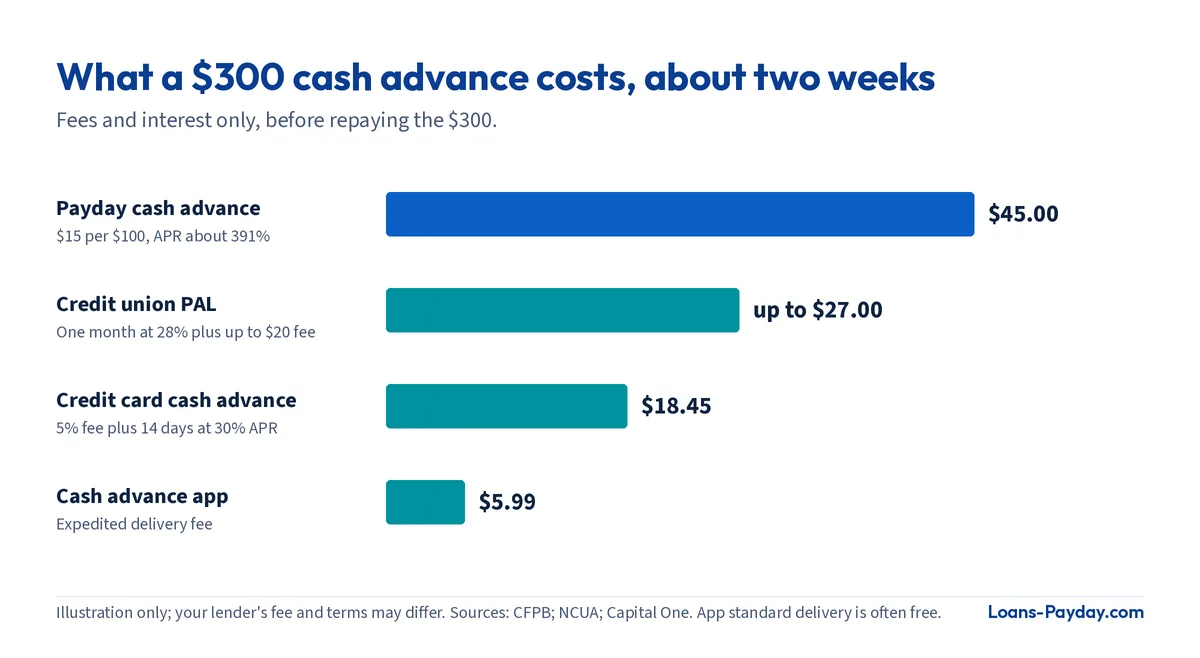
On $300, a payday cash advance at $15 per $100 costs $45, an APR of about 391% for 14 days. A credit card cash advance with a 5% fee and, say, a 30% cash advance APR costs about $18.45 if you repay it in 14 days: $15 in fees plus $3.45 in interest. Counting the fee, that is still an annualized cost of roughly 160%. An earned wage access app charging $5.99 for expedited delivery costs $5.99, or nothing if you wait for the free transfer. A credit union payday alternative loan at the 28% maximum, repaid in one month, costs up to $27, including an application fee of up to $20.
| Option | Cost on $300 | How the cost is figured |
|---|---|---|
| Payday cash advance | $45.00 | $15 per $100 for 14 days; you repay $345; APR about 391% |
| Credit card cash advance | $18.45 | 5% fee ($15.00) plus 14 days of interest at 30% APR ($3.45); ATM fees may be extra |
| Earned wage access app, expedited delivery | $5.99 | Top of the $2.50 to $5.99 range the CFPB cites; standard delivery is often free and takes one to three days |
| Credit union payday alternative loan (PAL) | Up to $27.00 | One month of interest at 28% ($7.00) plus an application fee of up to $20 |
Illustration only; your lender’s, card issuer’s or app’s fees may differ. The card fee and APR are examples, not quotes. Payday fees and limits vary by state.
To see the fee, total and APR for your own amount and term, use the payday loan calculator. It also shows what each rollover adds.
How does a payday cash advance work online?
You send one request online, a lender reviews it, and you accept or decline its terms. Through Loans-Payday.com the process usually runs like this:
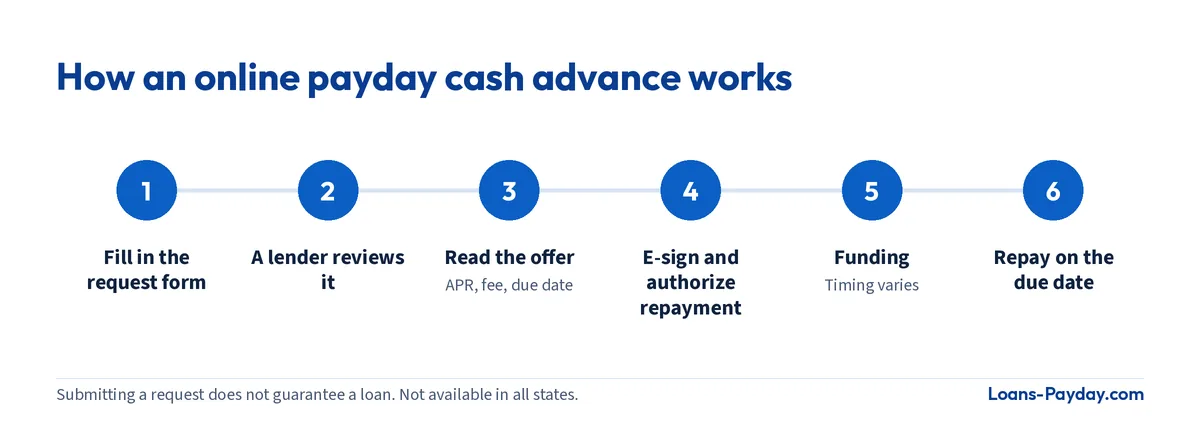
- Fill in the request form with the amount you need ($100 to $2,500), your income, your checking account and your contact details. Loans-Payday.com passes it to lenders in its network; it does not make the credit decision, set the fee or fund the loan.
- A lender reviews it. Lenders may still run soft or hard credit checks, but the CFPB says payday lenders generally don’t use your credit reports or scores to decide whether you’re eligible; some check specialty consumer reporting companies instead. Submitting a request does not guarantee a loan. The payday loan requirements page lists what lenders usually ask for.
- Read the offer before you sign. Under Regulation Z, the lender must disclose the finance charge in dollars and the APR before the loan is final (12 CFR 1026.17 and 1026.18). Check the due date and the total you will repay.
- Sign electronically and authorize repayment. Payday lenders generally ask for a post-dated check or your permission to debit your bank account on the due date (CFPB).
- Receive the money. Lenders may fund as soon as the next business day, sometimes the same day, depending on the lender, the time you apply and your bank.
- Repay on the due date, usually two to four weeks later. If the debit fails, your bank may charge an overdraft or returned-payment fee. In CFPB research published April 20, 2016, half of online payday borrowers had at least one debit attempt that failed or overdrew their account, and those borrowers paid an average of $185 in bank penalty fees.
Payday cash advances are not available in every state.
Payday loan vs cash advance app: which costs less?
An app advance often costs fewer dollars than a payday loan, but the amount you can get may be smaller. A payday loan app is simply a lender’s or referral service’s mobile way to apply for a payday loan, so the loan, the fee and the state rules stay the same. A cash advance app that offers earned wage access pays you part of your wages early. Its expedited delivery fees, typically $2.50 to $5.99 according to the CFPB, sit well below the $45 a $300 payday loan costs at $15 per $100, and most providers also offer a free transfer that takes one to three days. The trade-off is the amount: an employer-partnered app caps you at wages already earned, and a direct-to-consumer app sets its own estimate.
Advertised limits and actual limits can differ. On March 27, 2025, the Federal Trade Commission (FTC) announced that cash advance app Cleo AI agreed to pay $17 million to settle charges that it advertised advances of hundreds of dollars when “almost no one received anything close to the advertised amounts,” charged extra for speed and made its subscription hard to cancel. Before you rely on an app, check what it will actually advance you, every fee, and how to cancel.
How federal rules treat cash advance apps
Under a December 23, 2025 CFPB advisory opinion, “covered” earned wage access is not credit under Regulation Z. To be covered, an advance must not exceed wages already earned, must be repaid through a payroll deduction, must come with a clear disclosure and promise that the provider has no claim against you if the deduction falls short and will not use debt collection or report to credit bureaus, and must not involve a check of your credit risk (Federal Register, 90 FR 60069). The opinion also says delivery fees and tips are generally not finance charges. It did not decide whether other apps, including ones that debit your bank account after payday, are credit.
Federal positions have shifted several times. According to the December 2025 notice, the CFPB rescinded its 2020 EWA advisory opinion on January 15, 2025, and withdrew both that opinion and the rescission in May 2025; the December 2025 notice itself formally withdrew a 2024 proposal that would have treated all EWA as credit. Because covered EWA is not credit under Regulation Z, the app may not show you an APR, so compare costs in dollars. States add their own rules: as of April 2025, California, Kansas, Missouri, Nevada, South Carolina and Wisconsin required EWA providers to hold a license or register, Utah’s 2025 law added a registration requirement, and Arkansas also passed an EWA law in 2025 (Mayer Brown, April 21, 2025).
Is a cash advance right for you?
A cash advance fits a one-time, small expense you can repay in full on the due date. The CFPB notes that payday lenders do not generally verify your ability to repay, so that check falls to you. Before you borrow, subtract the full repayment from your next paycheck and see whether rent, food and other bills are still covered. If they aren’t, you may end up rolling the loan over. In CFPB research published March 25, 2014, 22% of new payday loans led to six or more renewals, and the CFPB said one in five new payday loans ended up costing the borrower more than the amount borrowed. Never take a payday cash advance to pay off another loan. If the company you owe will give you a short grace period or a payment plan, that may cost less than any advance.
If you are an active-duty servicemember or a covered dependent, the Military Lending Act limits payday loans and many other kinds of consumer credit to a 36% Military Annual Percentage Rate, which counts finance charges, credit insurance, add-on products and certain fees (CFPB, “What is covered under the Military Lending Act?,” last reviewed July 27, 2023).
How do you choose a cash advance lender?
Check the lender’s state license, the total cost in dollars and the repayment terms before you sign.
- Confirm the lender is licensed where you live. The FTC says lenders must register where they do business and suggests checking with your state attorney general or banking regulator. The payday loan laws by state page lists each state’s rules and regulator.
- Compare the total cost. Look at the finance charge in dollars and the APR on the Truth in Lending disclosure, and compare them with a card advance, an app or a credit union loan.
- Know how you will repay. Find the due date and the account the lender will debit. You can revoke a debit authorization by telling the lender, ideally in writing, and your bank; a stop-payment order must reach your bank at least three business days before the scheduled payment, and banks often charge for it (CFPB). Revoking the debit does not cancel what you owe.
- Ask what happens if you can’t pay on time: the late and returned-payment fees, whether rollovers are allowed and what they cost, and whether your state requires an extended payment plan.
- Refuse any fee charged before you get the money. The FTC says an upfront fee demanded before a loan is granted is a cue to walk away.
What are the red flags of a cash advance scam?
An upfront fee, a promise of approval or a request for payment by gift card is a common sign of a loan scam. The FTC says any fee a lender wants before granting the loan, often labeled “insurance,” “processing” or “paperwork,” is a cue to walk away, and that “banks and other legitimate lenders won’t promise or guarantee you a loan or credit before you apply” (“What To Know About Advance-Fee Loans,” July 2022). Scammers may also ask you to load a gift card and read them the numbers, or to pay by wire or cryptocurrency, which is hard to recover. A lender not registered in your state is another warning sign. If you spot a scam, report it to the FTC at ReportFraud.ftc.gov, and send complaints about a lender or app to the CFPB.
What are cheaper alternatives to a cash advance?
A credit union payday alternative loan caps interest at 28%, far below the CFPB’s payday example of almost 400%. Under National Credit Union Administration (NCUA) rules at 12 CFR 701.21, federal credit unions may offer two kinds. PAL I loans run from $200 to $1,000 over one to six months, and you must be a member for at least one month first. PAL II loans go up to $2,000 over one to twelve months, without a membership waiting period. Both cap the application fee at $20, allow no rollovers, and limit you to one PAL at a time and three in any rolling six-month period. The maximum rate is 10 percentage points above the NCUA’s general loan ceiling, which the NCUA Board kept at 18% through September 10, 2027, for a PAL cap of 28%.
Ask the company you owe for a payment plan or a later due date, ask your employer whether it offers a paycheck advance, and, if you already have a credit card, compare its cash advance terms with the payday offer. The payday loan alternatives guide covers more options, and how payday loans work explains the mechanics in full.
Cash advance FAQs
Is a cash advance the same as a payday loan?
A payday cash advance and a payday loan are the same product under Regulation Z. A credit card cash advance and an earned wage access advance are different products with different costs and rules, so check which one an ad means.
How fast can I get a cash advance?
A card advance at an ATM is cash in hand when you withdraw it. Payday lenders may fund as soon as the next business day, sometimes the same day, depending on the lender, the time you apply and your bank. Earned wage access apps typically offer a free transfer that takes one to three days, or faster delivery for a fee (CFPB).
Can I get a cash advance with bad credit?
Some payday lenders consider applicants with low credit scores, but approval is not guaranteed. The CFPB says payday lenders generally don’t use your credit reports or scores to decide whether you’re eligible; some check specialty consumer reporting companies instead, and lenders may still run soft or hard credit checks. Covered earned wage access programs do not assess credit risk. The payday loans with bad credit guide explains how lenders decide.
How much money can I get?
Through Loans-Payday.com you can request $100 to $2,500, but the amount offered depends on the lender, your income and your state’s law. The CFPB says a common payday loan limit is $500, with limits above and below that amount.
Are cash advance apps loans?
Under federal truth-in-lending rules, covered earned wage access is not credit, according to the CFPB’s December 23, 2025 advisory opinion. Covered means the advance stays within earned wages, is repaid by payroll deduction, carries no collection or credit reporting, and the provider does not assess your credit risk. The CFPB left the question open for other apps, and some states regulate them under their own laws.
Are payday cash advances legal in every state?
No, state law decides whether payday cash advances are allowed. Where they are allowed, states set limits on amounts, fees and rollovers, and some states do not permit them at all. The state-by-state laws guide linked above lists your state’s rules and its regulator.
What happens if I can’t repay a cash advance?
With a payday cash advance, the lender may debit your account on the due date and try again if the payment fails; in CFPB research published April 20, 2016, online lenders tried again about three-quarters of the time. Each failed attempt can bring a bank fee. Contact the lender before the due date to ask about a payment plan. You can revoke a debit authorization, but you still owe the balance (CFPB). The guide to what happens if you can’t repay a payday loan walks through your options step by step.
Updated October 2026. This page is general information, not financial or legal advice.