A payday loan calculator shows what a short-term loan will cost before you borrow. Enter the amount, the fee per $100 and the term to see the fee, the total you repay and the APR. At $15 per $100, which the Consumer Financial Protection Bureau (CFPB) calls common, a $300 two-week loan costs $45, so you repay $345.
Loans-Payday.com is a free referral service, not a lender; we may be paid by lenders in our network. The calculator gives an estimate, not an offer. The lender and your state’s law set the fee, term and APR you would actually pay, and the CFPB says a payday lender must disclose the APR and other costs before you agree to the loan.
How do you use the payday loan calculator?
Enter four numbers and the calculator returns the fee, the total to repay and the APR. It opens on a $300 loan at $15 per $100 for 14 days with no rollovers, so you can see a typical case before you change anything.
- Loan amount: any figure from $100 to $2,500, the range you can request through Loans-Payday.com.
- Fee per $100: the flat charge the lender adds for every $100 borrowed. If you have a lender’s written disclosure, use its number.
- Loan term in days: the time until payment is due, usually your next payday.
- Number of rollovers: how many times you pay only the fee and push the due date back by another term.
To compare two offers, run each one with its own fee and term. Two loans with the same fee can carry very different APRs when their terms differ.
How is a payday loan fee calculated?
A payday loan fee is a flat finance charge for every $100 you borrow, paid when the loan comes due. The calculator multiplies the amount by the fee per $100 and divides by 100. The CFPB’s page on payday loan costs (last reviewed November 2024) says the charge can range from $10 to $30 per $100, depending on state law. Its “What is a payday loan?” page (reviewed May 2024) describes a high-cost loan, generally for $500 or less, usually repaid in one payment on your next payday, two to four weeks after you borrow.
What does a $300 payday loan cost?
A $300 payday loan at $15 per $100 for 14 days costs $45, so you repay $345. The fee is $300 × 15 ÷ 100 = $45. The APR is ($45 ÷ $300) × (365 ÷ 14) × 100, or about 391%. The CFPB uses the same $300 example and puts a two-week loan at $15 per $100 at an APR of almost 400%. This example is for illustration only; your lender’s fee and term may differ.
How much would a $500 payday loan cost?
A $500 payday loan at $15 per $100 for 14 days costs $75 in fees, for a total of $575. The APR is the same 391%, because APR depends on the fee rate and the term, not on the amount. With no rollovers, changing the term moves only the APR, while changing the fee per $100 moves both the dollar cost and the APR. At $10 per $100, the low end of the CFPB’s range, the same loan costs $50. At $30, the high end, it costs $150. The table shows the steps in between.
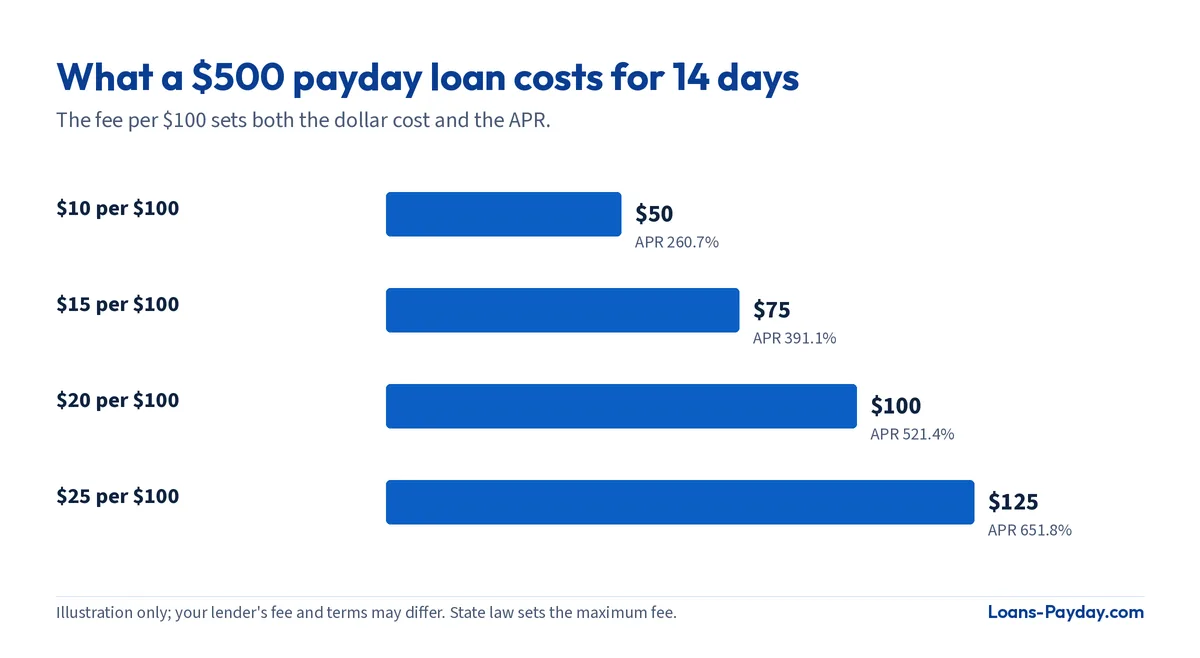
| Fee per $100 | Fee on $500 | Total to repay | APR (14 days) |
|---|---|---|---|
| $10 | $50 | $550 | 261% |
| $15 | $75 | $575 | 391% |
| $20 | $100 | $600 | 521% |
| $25 | $125 | $625 | 652% |
Illustration only: a $500 loan due in 14 days with no rollovers, using the calculator’s formulas. Your lender’s fee may differ, and many states cap payday loan fees.
Why is the APR so high when the fee looks small?
A small fee turns into a high APR because it covers a very short term. APR, the annual percentage rate, is the cost of credit expressed as a yearly percentage, and the CFPB says it lets you compare costs across different types of loans. The CFPB’s APR explainer (reviewed November 2024) shows the math: a $15 fee on $100 for 14 days is about $1.07 a day, which over 365 days comes to about $391, or 391% of the amount borrowed. The CFPB’s payday loan overview puts credit card APRs at about 12% to about 30%.
The term changes the APR even when the fee stays the same. A $45 fee on a $300 loan works out to about 182.5% APR over 30 days and about 391% over 14 days. For contrast, a federal credit union payday alternative loan can carry an interest rate of no more than 28%. National Credit Union Administration (NCUA) rules set that cap 10 percentage points above the federal credit union loan ceiling, which the NCUA Board kept at 18% through September 10, 2027 (NCUA, February 6, 2026).
What happens to the cost when you roll over a payday loan?
Each rollover adds another full fee while you still owe the original amount. The CFPB explains that where state law allows it, a rollover lets you pay only the fee when the loan is due; the lender then extends the due date and charges another fee for the new term. On the $300 example, one rollover means you pay $45 at two weeks and $345 at four weeks, which is $90 in fees and $390 in all.
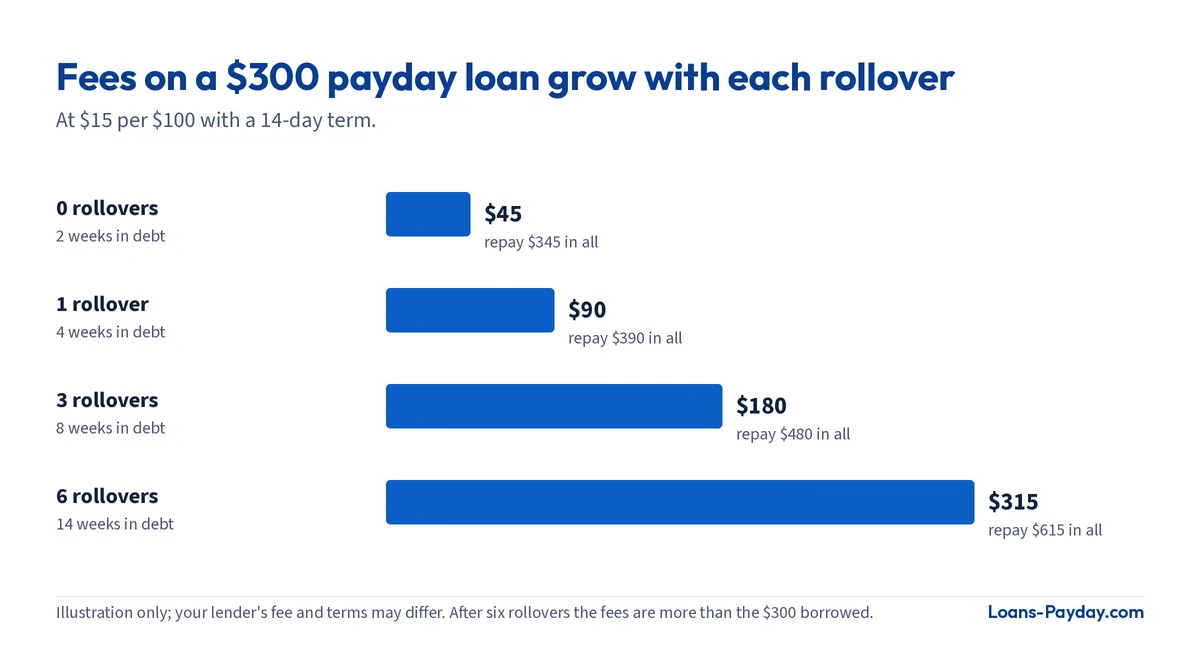
| Rollovers | Weeks in debt | Total fees | Total repaid |
|---|---|---|---|
| 0 | 2 | $45 | $345 |
| 1 | 4 | $90 | $390 |
| 3 | 8 | $180 | $480 |
| 6 | 14 | $315 | $615 |
Illustration only: a $300 loan at $15 per $100 with a 14-day term, using the calculator’s formulas.
After six rollovers, the fees ($315) are more than the $300 you borrowed, and you still owe the $300. Repeat borrowing like this is common. In a March 2014 report, the CFPB found that more than 80% of payday loans were rolled over or renewed within two weeks, and that for 22% of new loans, borrowers renewed six times or more. The calculator’s APR stays at 391% as you add rollovers, because each fee buys one more term at the same price. What grows is the dollar total. Some states require lenders to offer an extended repayment plan, which the CFPB says is different from a rollover and may or may not carry a fee. If the due date worries you, see what happens if you can’t repay a payday loan.
Payday loan fee limits depend on your state
State law decides whether payday loans are allowed where you live and how much lenders may charge. The CFPB says many states that allow payday lending cap the cost, the fees and the maximum loan amount, and that some states have no payday lending because their law doesn’t permit it. Before you rely on a number from the calculator, check your state’s rules in the payday loan laws by state guide. Active-duty servicemembers, including those on active Guard or Reserve duty, and their covered dependents have a separate federal limit. Under the Military Lending Act, they can’t be charged more than a 36% Military Annual Percentage Rate, which includes finance charges, credit insurance premiums and add-on products sold with the loan (CFPB, reviewed January 2024).
What costs does the calculator leave out?
The calculator counts only the lender’s fee per $100, so your real cost can be higher. The CFPB lists other charges that may apply depending on state law: late fees and returned-check fees from the lender, a nonsufficient funds (NSF) fee from your own bank if a payment fails, and loading, balance-check or monthly fees when a loan is paid onto a prepaid card. The tool also assumes one payment at the end of each term. A payday installment loan, repaid in several payments over a longer period, adds up differently, and the guide to installment loans explains how those payments work.
Are there cheaper ways to cover a short-term expense?
Cheaper options exist, starting with a credit union payday alternative loan capped at 28%. Under the NCUA rule at 12 CFR 701.21, a PAL I runs from $200 to $1,000 for one to six months and requires at least one month of membership, and a PAL II goes up to $2,000 for one to 12 months. Both limit the application fee to $20 and don’t allow rollovers. You can also ask the company behind the bill for a payment plan before you borrow at all. Never use a payday loan to pay off another loan. The payday loan alternatives guide compares more options by cost, speed and risk.

If you have compared the cost and still need a short-term loan, one request through Loans-Payday.com goes to lenders in our network. Submitting a request does not guarantee a loan, and any lender that makes you an offer must disclose the APR and other costs before you agree. How payday loans work covers the process from application to repayment.
Payday loan calculator FAQs
How much does a $100 payday loan cost?
At $15 per $100, a $100 payday loan costs $15, so you repay $115 on the due date. Across the CFPB’s range of $10 to $30 per $100, the fee would be $10 to $30. Over a 14-day term, the $15 fee equals an APR of about 391%.
Can I get a $2,500 payday loan?
You can request $100 to $2,500 through Loans-Payday.com, but whether a lender offers that much depends on the lender, your income and your state’s law. The CFPB says payday loans are generally $500 or less and that $500 is a common state limit. For illustration, at $15 per $100 a $2,500 two-week loan would cost $375 in fees, or $2,875 in total.
Why doesn’t the APR change when I add rollovers?
The APR measures the price of one term, and a rollover repeats that same price for another term. A $300 loan at $15 per $100 for 14 days is about 391% APR whether you roll it over or not. What changes is the total: six rollovers bring the fees to $315 and the total repaid to $615.
Is a payday loan fee the same as interest?
A payday loan fee is a finance charge, the dollar cost of the credit, even when the lender doesn’t call it interest. The CFPB uses APR to put that charge on the same yearly basis as the interest on other loans. That is why a fee equal to 15% of the amount borrowed and an APR of almost 400% can describe the same two-week loan.
Will the APR on my loan agreement match the calculator?
It may be close for a single-payment loan with no other charges, but the lender’s written disclosure is the number that counts. The CFPB says a payday lender must disclose the APR and other costs before you agree to the loan. Extra fees, rounding or a term counted differently can make the disclosed APR differ from this estimate.
Updated October 2026. This page is general information, not financial or legal advice.