A payday loan is a small, high-cost loan, usually $500 or less, that you repay in one payment on your next payday, typically two to four weeks later. You give the lender a post-dated check or permission to debit your bank account, and on the due date the lender collects the loan plus its fee.
That is how the Consumer Financial Protection Bureau (CFPB) describes the product. This guide covers each step, what the fee works out to as an annual rate, and how payday loans compare with cheaper options. Loans-Payday.com is a free referral service, not a lender; we may be paid by lenders in our network.

What is a payday loan?
A payday loan is a short-term, single-payment loan meant to cover expenses until your next paycheck. The CFPB describes it as a high-cost loan “generally for $500 or less” that is usually repaid in one lump sum on your next payday, or when other income such as a pension or Social Security arrives (CFPB, “What is a payday loan?”, reviewed May 28, 2024). Many states cap the loan size, and $500 is a common limit. The Federal Trade Commission (FTC) notes that payday loans are also called cash advance loans. Payday lenders also do not generally check whether you can repay the loan while still meeting your other bills, according to the CFPB.
Through Loans-Payday.com you can request $100 to $2,500. What a lender actually offers depends on the lender, your income and the law in your state, so many borrowers will be offered less than the top of that range.
How does a payday loan work, step by step?
A payday loan moves through five steps, from application to repayment on your next payday.
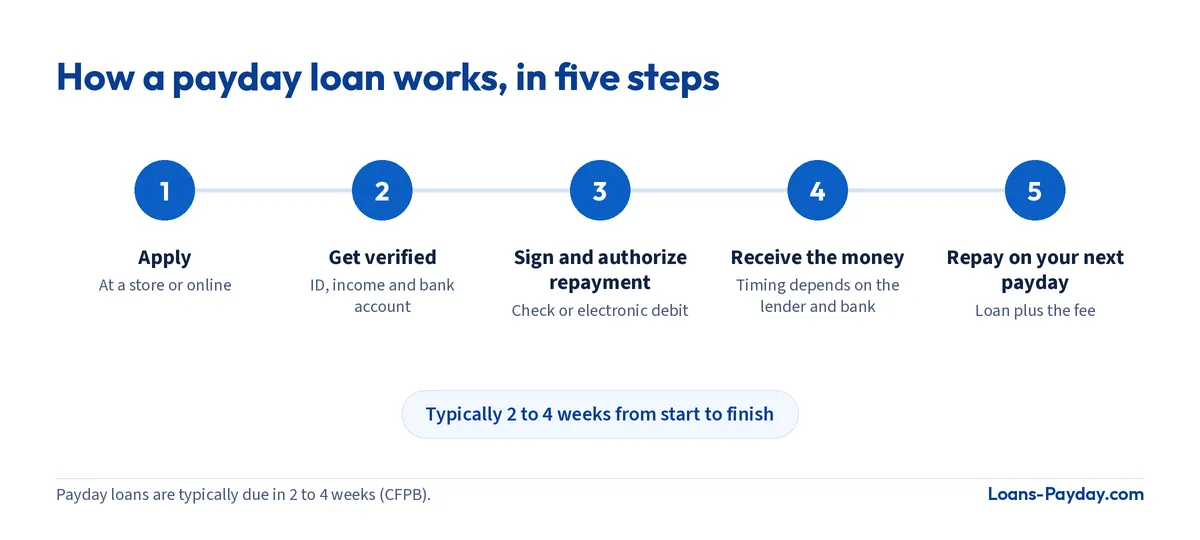
- Apply. You apply at a store or online, depending on what your state allows. Lenders generally ask for an active bank, credit union or prepaid card account, proof of income, valid ID, and an age of at least 18 (CFPB, “What do I need to qualify for a payday loan?”, reviewed August 26, 2024). Through a referral service such as Loans-Payday.com, one form goes to lenders in its network.
- Get verified. The lender confirms your identity, income and bank account. Lenders may still run soft or hard credit checks. The CFPB says payday lenders generally don’t use your credit reports or scores to decide, though some use information from specialty consumer reporting companies, and some online lenders pull your credit report to confirm your identity or check for a bankruptcy.
- Review the agreement and authorize repayment. The lender must give you the finance charge and the annual percentage rate (APR) in writing before you sign, according to the FTC. You then either write a post-dated check for the full balance, fees included, or authorize the lender to debit your account electronically. Online lenders may require the debit.
- Receive the money. Online lenders often deposit the money straight into your checking account, the CFPB found in 2016. Funds loaded onto a prepaid card can carry their own fees, the CFPB notes. A store may hand you cash or a check. Lenders may fund as soon as the next business day, sometimes the same day, depending on the lender, the time you apply and your bank.
- Repay on the due date. On your next payday the lender cashes the check or debits your account for the loan plus the fee. If the money isn’t there, the lender may try again, and your bank may charge a non-sufficient funds (NSF) or overdraft fee when a payment fails.
How much does a payday loan cost?
Payday loan fees typically run $10 to $30 for every $100 borrowed, and $15 per $100 is common. In the CFPB’s example (“What are the costs and fees for a payday loan?”, reviewed November 25, 2024), a $300 loan at $15 per $100 carries a $45 fee, so you repay $345 two weeks later. The CFPB says that fee equals an APR of almost 400%; the FTC puts it at 391%. The math: $15 is 15% of $100 for 14 days, a year holds about 26.07 two-week periods (365 divided by 14), and 15% times 26.07 is about 391%.
The fee is the catch. A $45 charge sounds manageable, but it buys only two weeks, and paying it again to extend the loan doubles the cost while the $300 stays unpaid. The CFPB adds that lenders may charge late or returned-check fees, and your bank may charge an NSF fee if a payment bounces.
| Fee per $100 | Fee on $300 | Total due in 14 days | APR |
|---|---|---|---|
| $10 | $30 | $330 | About 261% |
| $15 | $45 | $345 | About 391% |
| $20 | $60 | $360 | About 521% |
| $30 | $90 | $390 | About 782% |
Illustration only, using the CFPB’s $10 to $30 fee range. Your lender’s fee may differ, and many states cap it. APR = (fee / amount) x (365 / 14).
To run your own numbers, including rollovers, use the payday loan calculator.
What happens if you roll over or renew a payday loan?
A rollover means you pay only the fee to push back the due date, and the full balance stays owed. In the CFPB’s example, a $300 loan with a $45 fee is rolled over once by paying the $45; two weeks later you owe $300 plus another $45, and the loan has cost $90 instead of $45 (“What does it mean to renew or roll over a payday loan?”, reviewed November 25, 2024). Many states limit or ban rollovers. Some states require lenders to offer an extended payment plan, which splits the balance into smaller payments, sometimes at no added cost. If you can’t pay, the CFPB’s advice is to contact the lender right away and ask about a plan.
Most payday loans end up as part of a series. A CFPB study published March 25, 2014 found that more than 80% of payday loans were rolled over or renewed within 14 days, and that only 15% of borrowers repaid all their payday debts on time without borrowing again within 14 days. The Pew Charitable Trusts found in July 2012 that the average borrower was in debt about five months of the year and paid about $520 in interest on loans averaging $375. If you are already in that position, see what happens if you can’t repay a payday loan.
Are payday loans a good idea? The pros and cons
A payday loan fits one narrow case: a one-time expense you can repay in full on the due date. Outside that case, the fee and the pull toward borrowing again make it one of the most expensive ways to cover a gap.
What payday loans offer:
- Lenders generally don’t base the decision on your reports from the three nationwide credit bureaus, the CFPB says, so a low score may not rule you out.
- Money can arrive quickly, though timing depends on the lender, when you apply and your bank.
- You don’t pledge a car or other property, unlike a title loan.
What they cost you:
- An APR near 400% at the common $15 per $100 fee, per the CFPB.
- The whole balance is due at once, and most payday loans are renewed rather than repaid (CFPB, 2014).
- Failed debits can trigger bank fees on top of the lender’s charges (CFPB, 2016).
- On-time payments generally don’t build your credit, because most payday loans aren’t reported to the nationwide bureaus (CFPB).
Pew’s 2012 survey found that 69% of first-time borrowers used the loan for a recurring expense such as rent, utilities or food, and 16% for an unexpected one such as a car repair. A recurring bill comes back next month, and so does the gap. The FTC points to cheaper routes: asking the company you owe for more time, a payday alternative loan from a federal credit union, a small loan from a bank, nonprofit credit counseling, or help from family. Our list of payday loan alternatives compares them. Never take a payday loan to pay off another loan.
Online vs. storefront payday loans: what’s the difference?
Online and storefront payday loans work the same way but differ in how you apply, get paid and repay.
| Storefront | Online | |
|---|---|---|
| How you apply | In person, with ID and proof of income | Web form; income and bank details checked electronically |
| Who sees your information | The store you visit | The lender, or a network of lenders if the site is a lead generator |
| How you get the money | Cash, check or prepaid card, depending on the lender | Often direct deposit to your checking account |
| How you repay | Post-dated check or debit authorization | Usually automatic electronic debit |
| What to check first | State license | State license, plus the site’s privacy and opt-out policy |
| Main extra risk | Rollovers and renewals | Repeated debit attempts and bank fees; your data shared with several companies |
Many payday loan websites are lead generators rather than lenders, the CFPB explains (“What should I consider if I’m thinking about getting a payday loan online?”, reviewed November 25, 2024). They pass your details, including your Social Security and checking account numbers, to a network of lenders, and they may not find you the cheapest loan. Loans-Payday.com works this way: your request goes to lenders in our network, and the lender that makes an offer sets the terms. Before you submit any online form, the CFPB suggests reading the privacy and opt-out policies and confirming the lender is licensed in your state.
Electronic repayment carries its own risk. Studying online payday and installment loan payments over 18 months in 2011 and 2012, the CFPB found that about half of online borrowers had at least one debit attempt that overdrew their account or was rejected, and those borrowers paid an average of $185 in bank penalty fees (CFPB, April 20, 2016). Lenders retried about three-quarters of the time, and 70% of second attempts also failed. You can withdraw permission for automatic debits: tell the lender in writing, tell your bank or credit union, and place a stop payment order at least three business days before the next scheduled payment. The CFPB notes that revoking the authorization does not cancel the loan; you still owe the balance.
What types of payday loans are there?
Payday loans come in two main types, single-payment and installment, with three close relatives. Each is repaid differently and carries a different risk.
- A single-payment payday loan is the classic product described above: one loan, one fee, one repayment on your next payday. The catch is the rollover, which can turn a one-time loan into a series.
- A payday installment loan is a high-cost loan repaid in several scheduled payments over a few months instead of one lump sum, offered in states that permit it. Smaller payments are easier to fit into a budget, but a longer term at a high rate can mean more total interest. Check the APR and the total of payments in the agreement. Our guide to installment loans explains how the payments work.
- A vehicle title loan is a short-term loan secured by your car, usually due in 15 or 30 days and typically for 25% to 50% of the car’s value, according to the FTC (“What To Know About Payday and Car Title Loans”). Monthly fees can reach 25%, about a 300% APR. The catch is the car itself: a CFPB study published May 18, 2016 found that one in five borrowers with single-payment title loans had their vehicle seized or repossessed.
- A cash advance app advances part of your upcoming pay and takes it back from your account on payday. The fees and the rules differ from payday loans; see our guide to cash advances for how they compare.
- A credit card cash advance is cash borrowed against your credit card’s line. In a December 16, 2024 data spotlight, the CFPB found that most card agreements it reviewed charge a cash advance fee of the greater of $10 or 5%, that the typical cash advance APR is 30%, and that interest starts on the day of the transaction.
Labels such as “instant,” “faxless” or “bad credit” payday loans describe how a loan is marketed or applied for, not a different product. The fee, the due date and the repayment work the same way.
Is a payday loan secured or unsecured?
A payday loan is usually unsecured: you don’t pledge a car, a house or other property. The lender still has a direct line to your money. The post-dated check or the electronic debit authorization lets it collect straight from your bank account on the due date, and the CFPB notes that if you don’t repay on time, the lender can cash the check or withdraw the money. A vehicle title loan is different, because it is secured by your car, and the lender can repossess the car if you don’t pay.
A classic payday loan is also neither revolving credit nor an installment loan. It is a one-time loan repaid in a single payment, unlike a credit card or line of credit you can draw on again; a payday installment loan is an installment loan. Nor is it what lenders usually mean by a personal loan, which is repaid in monthly installments over months or years and priced as an APR rather than a flat fee per $100.
How do payday loans compare with other small-dollar loans?
Among the common small-dollar options, a credit union payday alternative loan (PAL) has the lowest price ceiling: 28% APR. Federal rules for PALs are set by the National Credit Union Administration (NCUA), which in February 2026 kept the 18% general loan rate ceiling for federal credit unions in place through September 10, 2027, with PALs allowed up to 28% (NCUA Letter 26-FCU-02).
| Option | Typical amount | How you repay | Cost | Main risk |
|---|---|---|---|---|
| Payday loan | Often $500 or less; state limits vary | One payment in 2 to 4 weeks | $10 to $30 per $100; $15 per $100 is about 391% APR | Rollovers and bank fees from failed debits |
| Payday installment loan | Set by state law and the lender | Several payments over months | Varies by state; check the APR and total of payments | More total interest over a longer term |
| Credit card cash advance | Up to your card’s cash advance limit | Monthly card payments | Fee of the greater of $10 or 5% in most agreements the CFPB reviewed; typical APR 30%, charged from day one | Fee plus immediate interest; needs an existing card |
| Credit union PAL | PAL I: $200 to $1,000. PAL II: up to $2,000 | Monthly payments over 1 to 6 months (PAL I) or 1 to 12 months (PAL II) | APR capped at 28%; application fee capped at $20 | Membership required (at least one month for PAL I) |
| Vehicle title loan | 25% to 50% of your car’s value | Usually one payment in 15 or 30 days | Monthly fees up to 25%, about 300% APR | Losing your car |
Sources: CFPB; FTC; NCUA and 12 CFR 701.21(c)(7), current as of October 2026. Amounts and costs vary by lender and state.
Under 12 CFR 701.21(c)(7), PALs can’t be rolled over, and a credit union may make no more than three to one borrower in a rolling six months, one at a time.
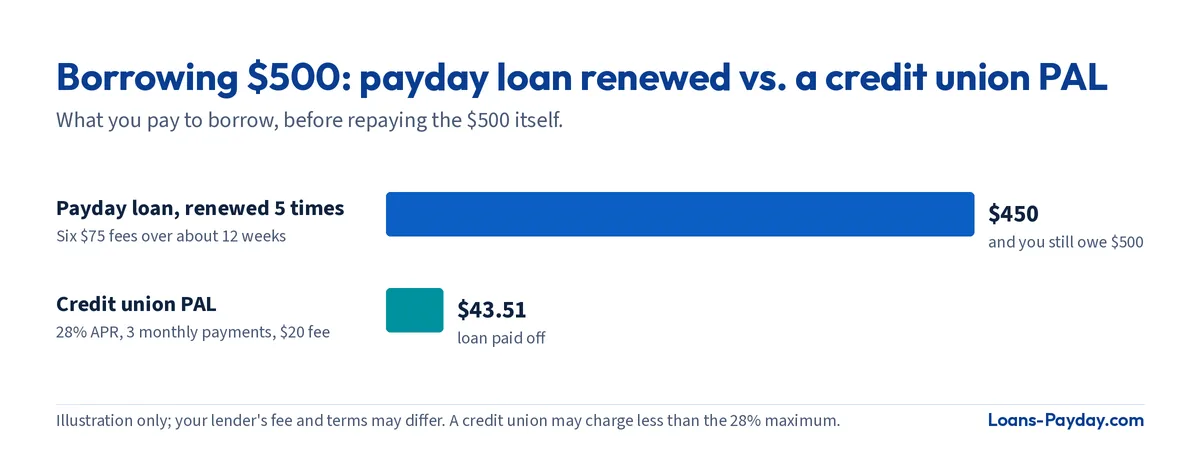
Example: borrowing $500 for about three months
Say you borrow $500 from a payday lender at $15 per $100, so each two-week loan costs $75. If you can’t repay and renew the loan five times, you pay six fees over about 12 weeks: $450 in fees, and you still owe the $500. Now say you borrow the same $500 as a PAL at the 28% maximum APR and repay it in three monthly payments. Each payment is about $174.50, the interest totals about $23.51, and with the largest allowed $20 application fee the loan costs about $43.51.
Illustration only. Your lender’s fee or rate may differ, many states limit or ban rollovers, and a credit union may charge less than the 28% maximum.
Do payday loans affect your credit score?
Taking out and repaying a payday loan usually doesn’t change your credit scores, for better or worse. The CFPB says payday loans are generally not reported to the three nationwide credit reporting companies, so on-time payments are unlikely to help you build credit (“Can taking out a payday loan help rebuild my credit or improve my credit score?”, reviewed November 25, 2024). Some payday lenders use specialty consumer reporting companies instead.
The damage comes if you don’t repay. If the lender sends or sells the debt to a debt collector, the collector may report it to the nationwide bureaus, and a collection account can hurt your scores. Some lenders and collectors sue over unpaid payday loans, and a court judgment could also appear on your reports. If your credit is already weak, our guide to payday loans with bad credit explains what lenders look at instead.
Who can get a payday loan, and where are payday loans legal?
Lenders generally require an active bank account, verifiable income, valid ID and an age of at least 18. Those are the CFPB’s general requirements; lenders and states can add more, as our page on payday loan requirements explains.
State law decides whether you can get a payday loan at all. The CFPB notes that some states don’t allow payday lending, many cap fees and loan sizes, and some allow rollovers while others limit or ban them. Online lenders should be licensed in your state, and licensed lenders may have to follow state rules that give you more protection. Check your state’s rules on our payday loan laws by state page, and confirm a lender’s license with your state regulator or attorney general.
Active-duty servicemembers, including those on active Guard or Reserve duty, and their covered dependents are protected by the Military Lending Act. It caps the Military Annual Percentage Rate (MAPR) at 36% on payday loans, vehicle title loans and most installment loans, and the MAPR counts finance charges, credit insurance, add-on products and certain other fees, not just interest (CFPB, “What is covered under the Military Lending Act?”, reviewed July 27, 2023). Lenders also can’t require arbitration or a military allotment, or charge a penalty for paying early. Servicemembers who need help can contact their legal assistance (JAG) office.
What are the red flags of a payday loan scam?
A lender that guarantees you a loan in exchange for an upfront fee is a classic scam sign. The FTC describes advance-fee loan scams that promise credit regardless of your history, then demand a “processing,” “insurance” or “paperwork” fee before any money arrives (“What To Know About Advance-Fee Loans,” July 21, 2022). Real lenders may charge an application fee, the FTC notes, but none guarantees a loan in exchange for payment. Watch for:
- A guarantee of approval, or ads that say bad credit doesn’t matter at all.
- A demand for payment before the loan arrives, especially by gift card, wire transfer or cryptocurrency.
- Unsolicited calls offering a loan. The FTC notes that telemarketers can’t legally ask for upfront payment for a loan.
- No license or registration in your state. Lenders must be registered in the states where they operate, and you can check with your state attorney general or banking regulator.
- A website with no street address, phone number or email you can find, which the CFPB flags as a concern.
- An agreement that doesn’t show the finance charge and APR in writing before you sign.
Report a suspected scam to the FTC at ReportFraud.ftc.gov. You can submit a complaint about a payday lender to the CFPB online or by calling (855) 411-2372.
Payday loan FAQs
Is a payday advance the same as a payday loan?
Generally, yes: “payday advance” is a common name for a payday loan, and the FTC notes that payday loans are also called cash advance loans. A credit card cash advance and a cash advance app are different products, repaid differently and priced differently.
How long do you have to repay a payday loan?
Most payday loans are due in two to four weeks, on your next payday. The CFPB says the due date is set in the agreement and may match other income, such as a pension or Social Security payment.
Do payday lenders check your credit?
Most payday lenders check something, even if not a standard credit report. The CFPB says payday lenders generally don’t use your credit reports or scores to decide, though some use information from specialty consumer reporting companies. Lenders may still run soft or hard credit checks.
What happens if a payday loan payment bounces?
The lender may try the debit again, and each failed attempt can cost you a bank fee. The lender may add late or returned-payment fees too. Contact the lender before the due date and ask about an extended payment plan.
Can military members get payday loans?
Yes, but the Military Lending Act caps the cost for active-duty servicemembers and covered dependents at a 36% Military APR, which counts finance charges, add-on products and certain other fees, according to the CFPB.
Updated October 2026. This page is general information, not financial or legal advice.