Yes, you can request a payday loan with bad credit. Payday lenders generally don’t use your credit reports or scores to decide whether you’re eligible, according to the Consumer Financial Protection Bureau (CFPB). They look at your income, your bank account and your ID instead. The catch is the price: a common fee of $15 per $100 borrowed works out to an APR of almost 400% on a two-week loan.
Loans-Payday.com is a free referral service, not a lender; we may be paid by lenders in our network. Below: what lenders check when your score is low, what “no credit check” means, what the loan costs, and which cheaper options to try first.

Can you get a payday loan with bad credit?
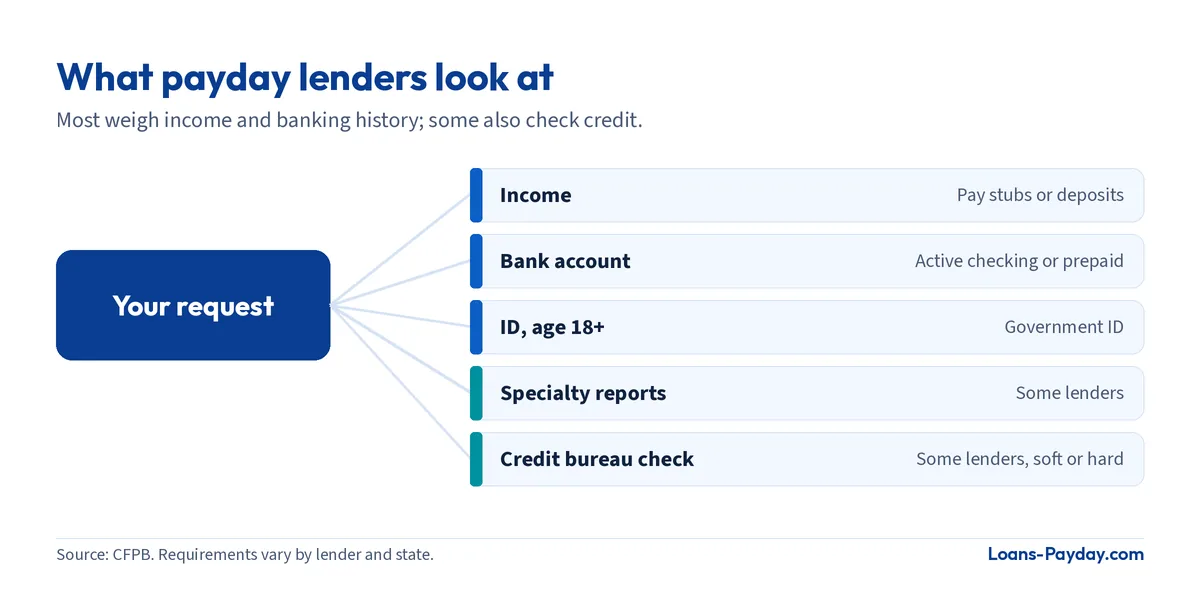
Often yes: the CFPB says payday lenders generally don’t use your credit reports or scores to decide whether you’re eligible; some check specialty consumer reporting companies instead, and lenders may still run soft or hard credit checks. The CFPB says payday lenders generally require an active bank, credit union or prepaid card account, proof or verification of income from a job or another source, and valid ID, and you must be at least 18. A request can still be turned down because of income the lender can’t verify, a specialty report the lender relies on, your state’s law or the lender’s own criteria. Submitting a request does not guarantee a loan.
A payday loan is usually a short-term, high-cost loan, generally for $500 or less, that is typically due on your next payday, according to the CFPB. “Bad credit” has no single official definition. On the FICO Score 8 scale, myFICO labels scores of 579 and lower “Poor” and 580 to 669 “Fair.” With a score in either band, a bank loan may be harder to get, while a payday lender may still review your request based on income.
State law decides whether payday loans are allowed where you live and how large they can be, and the CFPB notes that many states cap the loan amount; see payday loan laws by state. If you are an active-duty servicemember or a dependent, the Military Lending Act caps the Military Annual Percentage Rate on your loan at 36%, according to the CFPB.
What payday lenders check instead of your credit score
Payday lenders check that you have regular income, an open bank account and a verified identity. The CFPB says these lenders generally don’t use reports or scores from the three nationwide credit reporting companies, Equifax, Experian and TransUnion, to decide eligibility, but some do use information from specialty credit reporting companies. Each lender decides how it verifies income. The bank account matters twice, because the money is sent there and the lender usually collects repayment from it on your next payday. The full checklist is in the payday loan requirements guide.
Specialty consumer reporting companies
A specialty consumer reporting company collects data on one narrow part of your financial life, such as payday loan repayments or checking account history. The CFPB’s List of Consumer Reporting Companies, current as of January 2025, groups several under low-income and subprime consumers: Clarity Services, DataX, FactorTrust (owned by TransUnion), MicroBilt and Teletrack. In their own descriptions to the CFPB, Clarity and DataX say they collect payday and installment loan histories, and FactorTrust and Teletrack say short-term or payday lenders use their data. Other companies, such as Chex Systems and Early Warning Services, report on checking accounts, and the CFPB says those reports can include bounced checks and overdrafts.
You can see these files. Each of the five subprime-focused companies told the CFPB it gives one free report every 12 months on request. If a lender turns you down because of information in any consumer report, it must give you the reporting company’s name, address and phone number; you can then get a free copy from that company within 60 days and dispute anything that’s wrong, according to the CFPB.
Soft and hard credit inquiries
A soft inquiry is a credit check that doesn’t affect your scores, the CFPB explains. A hard inquiry is one a lender makes when you apply for credit, and it can affect them. Checking your own report is a soft inquiry. A payday lender may run either kind, or use a specialty company instead, so read the lender’s disclosures and ask which check it runs. Any lender that reviews a request sent through Loans-Payday.com may check your credit with one or more credit bureaus.
Are “no credit check” payday loans real?
A “no credit check” loan usually means the lender skips the nationwide bureaus; it still checks other things. Lenders verify your income, identity and bank account, and some use reports from the specialty companies above, which track payday and installment loan histories. So a “no credit check” ad can still lead to a check of other data and a decline. Be most careful when the ad also makes a promise. The Federal Trade Commission (FTC) lists “Bad credit? No problem” and guarantees of credit before you apply among the warning signs of advance-fee loan scams, in guidance updated August 2026. A legitimate lender can say no.
How much does a payday loan cost?
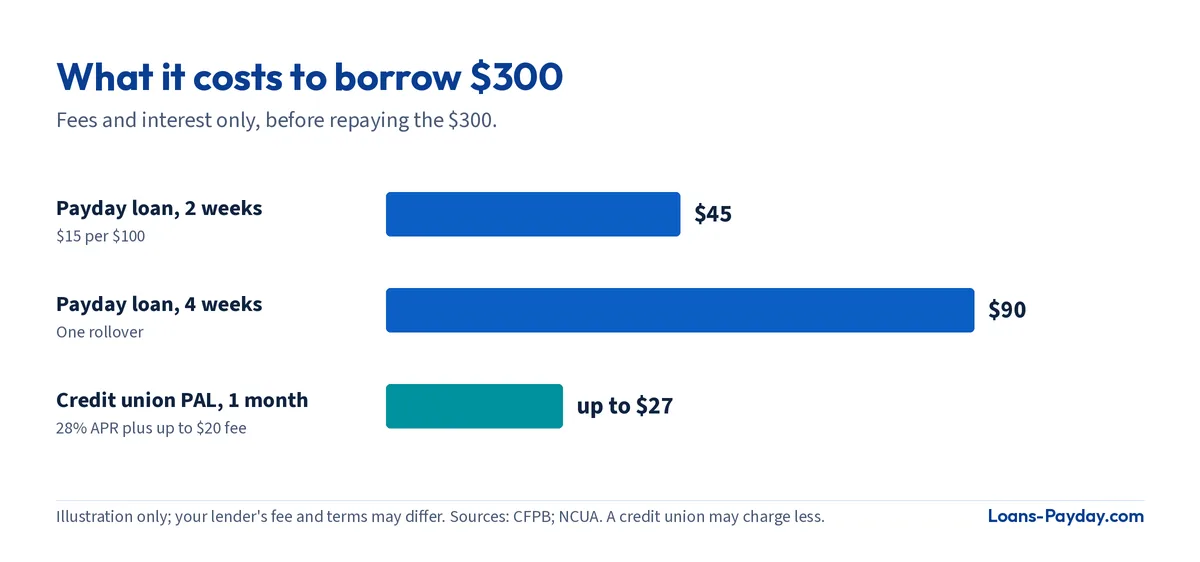
A payday loan typically costs $10 to $30 for every $100 borrowed, usually for two weeks, according to the CFPB. At the common $15 per $100, a $300 loan carries a $45 fee and you repay $345 on your next payday, an APR of almost 400%. APR, the annual percentage rate, is the yearly cost of credit with fees included, so it lets you compare a two-week loan with a credit union loan on equal terms. The lender sets your fee within your state’s limits; Loans-Payday.com does not set rates or fees.
| Fee per $100 | Fee on $300 for 14 days | Total to repay | APR |
|---|---|---|---|
| $10 | $30 | $330 | About 261% |
| $15 | $45 | $345 | About 391% |
| $20 | $60 | $360 | About 521% |
| $30 | $90 | $390 | About 782% |
Illustration only; your lender’s fee may differ. The $10 to $30 fee range comes from the CFPB. APR = (fee ÷ amount) × (365 ÷ 14 days) × 100.
Rollovers are where the cost climbs. Where state law allows it, a rollover lets you pay only the fee and move the due date, but you are charged another fee and still owe the full balance, the CFPB explains; on its $300 example, that is $90 in fees for four weeks of borrowing. A CFPB study released in March 2014 found that more than 80% of payday loans are rolled over or renewed within two weeks. Run your own numbers with the payday loan calculator before you apply.
How a request through Loans-Payday.com works
You fill in one form, and Loans-Payday.com passes your request to lenders in its network who may make an offer.
- Enter the amount you need ($100 to $2,500), your income and pay dates, your contact details and the bank account you want to use.
- Lenders review the request and may verify your identity and income and check your credit with a nationwide bureau or a specialty company.
- If a lender makes an offer, read its agreement for the amount, fee, APR, due date and repayment method before you sign. You can decline any offer.
- If you accept, you e-sign the agreement and usually authorize the lender to debit your account on the due date.
- Lenders may fund as soon as the next business day, sometimes the same day, depending on the lender, the time you apply and your bank.
What a lender offers depends on the lender, your income and the law in your state. The CFPB notes that payday loans are generally $500 or less and that many states cap the loan size. You can stop automatic debits: the CFPB says you can revoke the lender’s permission by telling the lender and your bank, or ask your bank for a stop payment order at least three business days before a scheduled payment. Revoking does not cancel the loan; you still owe the balance. More detail: how payday loans work.
Bad-credit borrowing options compared
A credit union payday alternative loan costs far less than a payday loan, with its interest rate capped at 28%. Not every option is offered everywhere, and each provider sets its own approval criteria.
| Option | Typical amount | Cost | What’s checked | Builds credit? | Main risk |
|---|---|---|---|---|---|
| Payday loan | Generally $500 or less; state caps vary | $10 to $30 per $100, usually for two weeks | Income, bank account, ID; some lenders use specialty reports | Generally not reported to the nationwide bureaus; collections can be | Rollovers and fees that stack |
| Payday installment loan | Varies by state and lender | Set by the lender within state law; check the APR | Similar to a payday loan | Ask the lender | More payments can mean more total fees |
| Credit union PAL I | $200 to $1,000, repaid over 1 to 6 months | Interest rate up to 28%; application fee up to $20 | The credit union’s own criteria; at least one month of membership | Ask the credit union | You must join; not every credit union offers PALs |
| Credit union PAL II | Up to $2,000, repaid over 1 to 12 months | Interest rate up to 28%; application fee up to $20 | The credit union’s own criteria | Ask the credit union | You must join; not every credit union offers PALs |
| Secured credit card | A credit line equal to your cash deposit | Fees and interest can be high | The issuer’s criteria plus the deposit | Yes, the CFPB lists it as a way to build credit | Ties up cash as a deposit; doesn’t fix a cash shortfall |
| Cash advance app (earned wage access) | Average advance of $106 in CFPB data | Fees of $1.99 to $5 per advance in CFPB data; some apps ask for tips | Varies by provider | Ask the provider | Small fees on short advances add up to high APRs |
Sources: CFPB; NCUA (12 CFR 701.21 and Letter 26-FCU-02, February 2026); CFPB Data Spotlight on paycheck advances, July 2024, covering employer-partnered providers in 2021 and 2022. Check each provider’s current terms.
Credit union payday alternative loans (PALs)
A payday alternative loan, or PAL, is a small loan that federal credit unions may offer under National Credit Union Administration (NCUA) rules in place of a payday loan. Under 12 CFR 701.21, a PAL I is $200 to $1,000 repaid over one to six months, after at least one month of membership; a PAL II is up to $2,000 over one to 12 months. The application fee is capped at $20, rollovers aren’t allowed, and you can have no more than three PALs in six months, one at a time. NCUA Letter 26-FCU-02 (February 2026) confirms federal credit unions may charge up to 28% on PALs, against an 18% ceiling on most other federal credit union loans through September 10, 2027.
For a rough comparison, borrowing $300 for one month at the PAL maximum of 28% means about $7 in interest plus an application fee of up to $20, or up to $27 in total. The CFPB’s payday example costs $90 for four weeks with one rollover. These are illustrations; a credit union’s actual rate and fee may be lower. You can search for credit unions near you with the NCUA’s Credit Union Locator.
Payday installment loans
A payday installment loan is a high-cost loan repaid in several scheduled payments instead of one lump sum on your next payday. Smaller payments can be easier to make, but a longer term can mean you pay more in total, so compare the total of payments, not only the payment size. Only some states allow these loans. The installment loans guide walks through the arithmetic.
Secured credit cards and credit builder loans
A secured credit card requires a cash deposit, for example $500 in the CFPB’s illustration, and lets you spend up to that amount. A credit builder loan from a bank or credit union holds the borrowed money while you make payments. The CFPB lists both as ways to rebuild credit and says payments on these products are reported to the three nationwide credit reporting companies; confirm with the provider before you sign up. Neither is quick cash, but either can lower what you pay to borrow next time.
Cash advance apps
A cash advance app, also called earned wage access, lets you get part of your pay before payday, usually for a fee. In its July 2024 Data Spotlight on employer-partnered providers, the CFPB found an average advance of $106; at the average fee of $3.18 over about 10 days, that equals an APR of about 109.5%, and about 82% of transactions carried a fee, most often for faster transfer. Direct-to-consumer apps weren’t in that data, and some ask for tips. Read more on cash advances and apps.
Do payday loans build credit or hurt it?
A payday loan usually won’t help your credit, but an unpaid one can hurt it. The CFPB says payday loans are generally not reported to the three nationwide credit reporting companies, so paying on time typically doesn’t raise your score. An unpaid loan sent to a debt collector could be reported to a nationwide bureau, and a court judgment from a payday loan lawsuit could also appear on your reports, the CFPB says. A hard inquiry, if the lender runs one, can lower your scores. Failed debits cost money too: the lender may charge late or returned-payment fees, and your bank may charge a non-sufficient funds (NSF) fee. If you’re already behind, read what happens if you can’t repay a payday loan.
Is a payday loan right for you with bad credit?
A payday loan fits only a one-time, short gap that you can repay in full from your next paycheck. It may make sense if you have ruled out the cheaper options above, you know where the full repayment will come from, and repaying won’t leave you short on rent or food. It is the wrong tool if you would likely need to roll it over, if the gap is long-term, or if you would use it to repay another loan. Other routes, including payment plans with the company you owe, are in payday loan alternatives.
Red flags of bad-credit loan scams
The clearest scam sign is a lender that wants money from you before you get the loan. The FTC’s guidance on advance-fee loans says “any up-front fee that the lender wants to collect before granting the loan is a cue to walk away,” and lists these other warning signs:
- A promise of approval regardless of your credit, such as “Bad credit? No problem” or “guaranteed.”
- Fees labeled “processing,” “insurance” or “paperwork” that you must pay first.
- Requests to pay by gift card, wire transfer or cryptocurrency.
- A lender that isn’t registered in your state. Lenders must register where they do business, and you can check with your state attorney general or banking regulator.
- Unsolicited calls offering loans.
The FTC puts it simply: “No one legitimate will ever ask you to pay for a promise.” Submitting a request through Loans-Payday.com is free. You can report a suspected loan scam at ReportFraud.ftc.gov.
How to improve your chances without paying for promises
The legitimate ways to improve your odds come down to giving lenders information they can verify. None of these steps costs money:
- Enter your income, pay dates and bank details exactly as they appear on your pay stub or bank statement, so a lender can verify them.
- Ask only for what you can repay from one paycheck while still covering your regular bills. A lender may offer less than you request.
- Check your credit reports for errors. The CFPB says you can view your reports from Equifax, Experian and TransUnion online for free once a week through AnnualCreditReport.com, and the specialty companies named above each offer one free report every 12 months. Dispute errors with the reporting company and the company that supplied the data.
- Confirm that payday loans are legal in your state before you apply.
- Don’t take a second payday loan to pay off the first.
Raising the score takes longer. Paying on time, every time, can help build a strong credit history and lower future borrowing costs, according to the CFPB.
Payday loans with bad credit FAQs
Can I get a payday loan with a 500 credit score?
Possibly, because payday lenders generally don’t decide on your credit score, according to the CFPB. They look for an active bank or prepaid card account, verifiable income and valid ID. A lender can still decline, and approval is not guaranteed at any score.
Do payday lenders do hard credit checks?
Some may, while others use a soft inquiry or a specialty company such as Clarity Services or FactorTrust. A hard inquiry can affect your scores and a soft one does not, according to the CFPB.
Is there a guaranteed payday loan for bad credit?
No. The FTC says legitimate lenders don’t promise credit before you apply, and it treats “Bad credit? No problem” guarantees as a sign of advance-fee loan scams.
Will paying off a payday loan improve my credit score?
Usually not. The CFPB says payday loans are generally not reported to the three nationwide credit reporting companies, though unpaid payday debt sent to collections can be.
Can I qualify with income from benefits instead of a job?
Possibly. The CFPB says payday lenders generally require proof or verification of income from a job or another source, and each lender decides which income it accepts.
What is the cheapest way to borrow a small amount with bad credit?
A credit union payday alternative loan usually costs far less than a payday loan, with an interest rate capped at 28% and an application fee of no more than $20 under NCUA rules. A payment plan with the company you owe may cost less still.
How fast can I get a payday loan with bad credit?
Lenders may fund as soon as the next business day, sometimes the same day. Timing depends on the lender, the time you apply and your bank, and your credit score doesn’t speed it up or guarantee it.
Updated October 2026. This page is general information, not financial or legal advice.