Payday loan alternatives are cheaper or lower-risk ways to cover a short cash gap: a payment plan on the bill itself, a credit union payday alternative loan capped at 28% APR, or a small loan from your own bank. This guide lists 15 options, with who each one suits, what it costs and the catch.
Loans-Payday.com is a free referral service, not a lender; we may be paid by lenders in our network. The options below are ordered by cost and risk to you, starting with the ones that add no new debt.

Why look for an alternative to a payday loan?
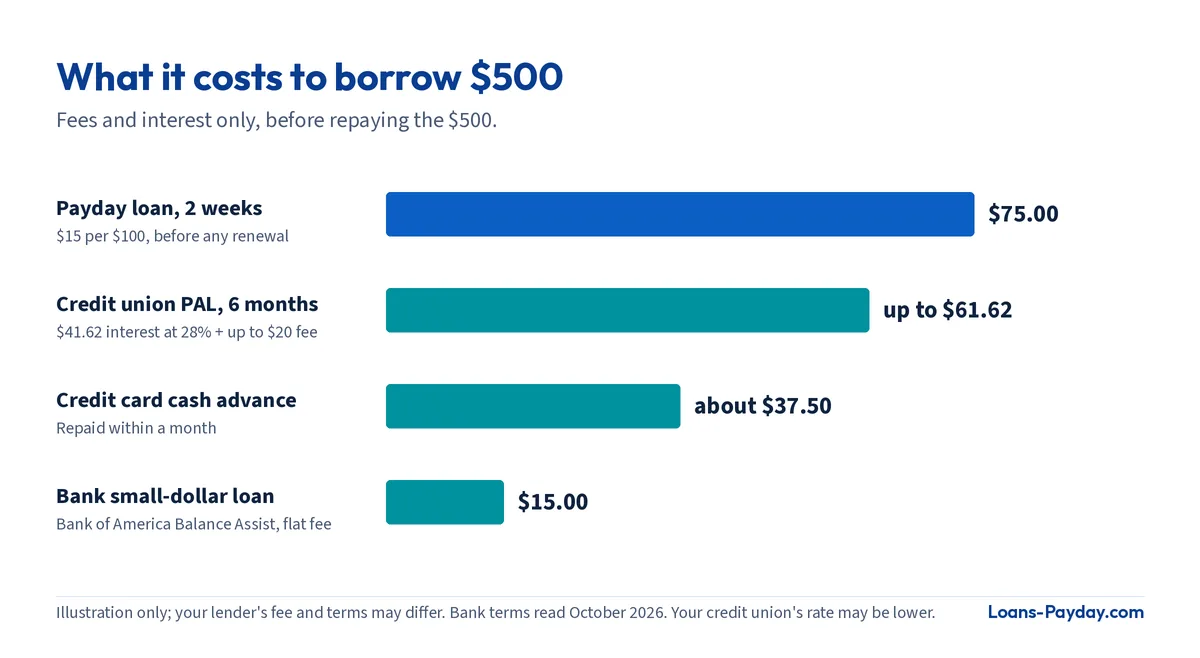
A typical payday loan costs about $15 per $100 borrowed for two weeks, an APR of almost 400%. The Consumer Financial Protection Bureau (CFPB) says payday fees range from $10 to $30 per $100 and that $15 is common, which equals an APR of almost 400% on a two-week loan (“What are the costs and fees for a payday loan?”, last reviewed November 2024). On a $500 loan, that is a $75 fee due in two weeks, about 391% APR (illustration only; your lender’s fee may differ). Repeat borrowing raises the cost further: CFPB research published in June 2016 found that more than 80% of payday loans were rolled over or reborrowed within 30 days, each time with a new fee. If an option below covers your need in time, it will usually cost less. For the mechanics, see how payday loans work, or try the payday loan calculator.
How do payday loan alternatives compare?
Options that add no new debt cost the least; overdraft and car title loans carry the most risk. Each figure below comes from the regulator or company named in that option’s section. Terms change, so confirm them with the provider before you apply.
| Option | Typical cost | How fast | Credit check | Main risk |
|---|---|---|---|---|
| Payment plan with the creditor | Often none; ask about extension fees | Once the creditor agrees | Usually none | Late fees if you miss the new dates |
| Hospital financial assistance | Free or discounted care if you qualify | Depends on the hospital | No; the hospital’s own eligibility rules apply | Paperwork; not every bill qualifies |
| 211, LIHEAP and local charities | Assistance, not a loan | Varies by agency | No | Funds and eligibility vary by area |
| Nonprofit credit counseling | Free or low cost; some services carry fees | Varies by agency | Not for counseling | Some agencies have defrauded people |
| Family or friends | Whatever you agree, often nothing | Can be same day | No | Strain on the relationship |
| Selling unused items | None | Depends on finding a buyer | No | You may get less than the item is worth |
| Employer paycheck advance | Ask your employer | Depends on payroll | Usually none | Smaller next paycheck |
| Credit union PAL | Up to 28% APR plus an application fee of up to $20 | Varies by credit union | Set by the credit union | Membership required |
| Bank small-dollar loan | Flat fees; 14.32% to 35.65% APR in the Bank of America and U.S. Bank examples | Varies by bank | Varies by bank | Existing checking customers only |
| Earned wage access app | Fees for instant transfers; optional tips | Instant transfers may cost extra | None for programs that meet the CFPB’s “covered EWA” definition | Smaller next paycheck |
| Credit card cash advance | Fee of $10 or 5%, whichever is greater; 30% APR most common | Same day at an ATM | None beyond having the card | Interest from day one |
| Personal installment loan | Up to 18% APR at federal credit unions; varies elsewhere | Varies by lender | Usually yes | More total interest on longer terms |
| Buy now, pay later | Depends on the plan’s terms | At checkout | Varies by provider | Several plans at once |
| Bank overdraft | Often around $35 per overdraft | At the moment you pay | The bank’s own rules | Several fees in one day |
| Car title loan | Monthly fees as high as 25%, about 300% APR | Varies by lender | Car title required | Losing your car |
Sources: NCUA, CFPB, FTC, Congressional Research Service and the banks’ published terms, read October 2026.
15 payday loan alternatives, from lowest cost to highest risk
Start with options that add no new debt, then move to the lowest-cost loans. The Federal Trade Commission (FTC) recommends several of the same steps in its guide to payday and car title loans.

1. Ask the creditor for a payment plan or more time
If a payday loan would pay one specific bill, call that creditor first and ask for more time or a payment plan. The FTC suggests this step and advises asking whether the extension carries a fee. For utilities, USA.gov notes that disconnection rules vary by state. Ask before the due date, get the new dates in writing and keep to them, because a missed arrangement can bring late fees.
2. Apply for hospital financial assistance
Tax-exempt hospitals must have a written financial assistance policy, according to the IRS (Section 501(r)(4)). The policy explains who qualifies for free or discounted care and how to apply. Before you borrow to pay a hospital bill, ask the billing office for the policy and the application. Expect paperwork, such as proof of income, and rules that differ from one hospital to the next.
3. Call 211 and check LIHEAP
Dialing 211 connects you, confidentially, with local help for bills, housing, utilities and food; the service is provided by more than 200 local organizations, including United Ways. The federal Low Income Home Energy Assistance Program (LIHEAP) can help pay heating or cooling bills, and you apply through your state’s LIHEAP office, according to USA.gov (updated January 2026). The FTC also points to local charities and churches. Funds and eligibility vary by area, so start before the bill is due.
4. Talk to a nonprofit credit counselor
A credit counselor can review your budget and debts, often for free or at low cost, according to the CFPB. With several debts, a counselor may suggest a debt management plan: one payment a month to the agency, which then pays your creditors. The National Foundation for Credit Counseling (NFCC), a nonprofit network of agencies, takes calls at 877-360-6322. Get any fees in writing. The CFPB, citing the FTC, warns that some agencies offering these plans have defrauded people, so confirm your creditors have accepted the plan before you pay.
5. Borrow from family or friends, with written terms
A loan from someone you know can cost nothing and arrive the same day. Write down the amount, the repayment dates and any interest, and both sign it. The risk is personal: a late repayment can damage the relationship.
6. Sell things you don’t use
Selling an unused phone, tool or piece of furniture raises cash you never repay. Finding a buyer can take days, and you will usually get less than you paid.
7. Ask your employer for a paycheck advance
Some employers will advance part of a paycheck you have already earned and take it back from a later one. Ask HR or payroll whether this exists and whether there’s a fee. Expect a smaller next paycheck.
8. Get a credit union payday alternative loan (PAL)
A payday alternative loan (PAL) is a small installment loan from a federal credit union, capped at 28% APR. The National Credit Union Administration (NCUA) sets the rules (12 CFR 701.21) in two versions. A PAL I runs from $200 to $1,000 for one to six months, and you must have been a member for at least one month. A PAL II can be up to $2,000 for one to 12 months, with no minimum membership period. Both cap the application fee at $20, ban rollovers, allow no more than three PALs in six months and one at a time, and must be paid off in installments by the end of the term. The 28% limit is NCUA’s 18% loan rate ceiling, extended in February 2026 to September 10, 2027, plus the 10 percentage points the PAL rule allows.
For example, a $500 PAL repaid over six months at 28% costs about $90.27 a month and $41.62 in total interest, plus an application fee of up to $20 (illustration only; your credit union’s rate may be lower). The same $500 as one two-week payday loan at $15 per $100 costs $75 before any renewal. The catch is access: you must join, not every federal credit union offers PALs, and approval is the credit union’s decision.
9. Ask your bank about a small-dollar loan
Some large banks lend small amounts to their own checking customers for far less than a typical payday fee. In May 2020, the Federal Reserve, FDIC, NCUA and OCC jointly encouraged banks and credit unions to offer responsible small-dollar loans. Published terms, read in October 2026:
- Bank of America Balance Assist: up to $500 for a flat $15 fee, repaid in four monthly payments. The bank’s example is $300 borrowed and $315 repaid, an APR of 23.77%.
- U.S. Bank Simple Loan: up to $1,000 at $6 per $100, repaid in three monthly payments. The bank’s example with automatic payments is $400 borrowed, a $24 fee and $424 repaid, an APR of 35.65%. You need a U.S. Bank personal checking account that has been open at least six months, with recurring direct deposits, and the loan is subject to credit approval.
- Huntington Standby Cash: $100 to $750 for checking customers who have deposited at least $1,000 a month for three consecutive months, among other requirements. It charges a 5% cash advance fee and no interest over three months with automatic payments; without them, 12% APR applies. Huntington says it doesn’t use your credit score to decide eligibility.
The catch is that these loans go to existing customers with a deposit history. If you bank elsewhere, ask your own bank or a community bank what it offers.
10. Use an earned wage access app with care
Earned wage access (EWA) lets you draw pay you have already earned before payday, often for a fee or an optional tip. In a December 23, 2025 advisory opinion, the CFPB said “covered EWA” is not credit under the Truth in Lending Act: programs that advance only earned wages, collect through payroll deduction rather than a debit from your bank account, have no recourse against you if the deduction falls short, and don’t check your credit. For example, a $5 fee on a $100 advance repaid in seven days works out to about 261% annualized (illustration only; fees vary by app). Look for a free standard transfer before paying for instant delivery. See the cash advance guide for more on apps.
11. Take a credit card cash advance
A credit card cash advance lets you withdraw cash against your card’s limit. In a December 2024 review of seven issuers’ card agreements, the CFPB found most charged the greater of $10 or 5%, the most common cash advance APR was 30%, and interest starts on day one with no grace period. For example, a $500 advance repaid within a month would cost a $25 fee plus about $12.50 in interest, about $37.50 in all (illustration only; check your card agreement).
12. Consider a personal installment loan
A personal installment loan is repaid in fixed payments over months instead of one lump sum. Federal credit unions can’t charge more than 18% APR on most loans under NCUA’s current ceiling; other lenders set rates within state law. A longer term lowers the payment but raises total interest, and some lenders deduct an origination fee from the loan. High-cost payday installment loans exist too; the installment loan guide shows how to tell them apart.
13. Use buy now, pay later only for a planned purchase
Buy now, pay later (BNPL) splits a purchase at a participating merchant into a few payments, often four. It usually won’t cover rent or bills. The risk is stacking: in a January 2025 study of 2022 data, the CFPB found about 63% of BNPL borrowers had more than one loan at the same time at some point in the year.
14. Don’t rely on overdraft
Overdraft lets your bank cover a payment your balance can’t, for a fee. Banks often charge around $35 per overdraft, according to the FDIC as cited by the Congressional Research Service (September 2025). That is 35% of a $100 overdraft before you repay it, and several fees can land in one day.
15. Treat a car title loan as a last resort
A car title loan uses your vehicle’s title as security. Title loans often carry monthly fees as high as 25%, about 300% APR, and you could lose your vehicle, according to the FTC. A May 2016 CFPB study found that one in five single-payment auto title loan borrowers had their car seized, and more than four in five of these loans were renewed the day they were due. If you need the car for work, losing it can cost more than the loan.
If you’re in the military
The Military Lending Act caps covered loans to servicemembers and their dependents at a 36% Military Annual Percentage Rate, according to the CFPB. Coverage includes people on full-time active duty, among them active Guard and Reserve members.
How was this list put together?
Options are ordered from lowest to highest cost and risk, using published fees and federal rules. No-debt options come first, then loans with regulated caps, then products whose costs grow with repeat use, with title loans last because they put your car at risk. Every figure comes from the regulator, agency or company named beside it, read in October 2026. No option is a paid placement, and the banks are named as examples of published terms, not endorsements.
When might a payday loan still be the option left?
If none of these options works in time, a payday loan may be the only choice left. Some states don’t permit payday loans, and in others lenders choose not to operate at the fees allowed, according to the CFPB, so check the payday loan laws in your state first. Borrow the smallest amount you can and plan to repay it in one payment rather than renewing. The CFPB says payday lenders generally don’t use traditional credit reports or scores to decide; some check specialty consumer reporting companies instead. Lenders may still run soft or hard credit checks; see payday loans with bad credit. Lenders may fund as soon as the next business day, sometimes the same day, depending on the lender, the time you apply and your bank. Never take a payday loan to repay another loan. If you already can’t repay one, read what happens if you can’t repay a payday loan.
What red flags should you watch for?
Any lender that wants a fee before you get the loan is a warning sign, according to the FTC. The FTC calls an up-front fee collected before a loan is granted “a cue to walk away.” It also warns about promises of credit regardless of your credit history, requests to pay by gift card, wire transfer or cryptocurrency, and lenders that aren’t registered in your state, since lenders must register where they do business.
Payday loan alternatives FAQs
What is the cheapest alternative to a payday loan?
The cheapest alternatives add no new debt: a payment plan with the creditor, hospital financial assistance, or help through 211 and LIHEAP. Among loans, a federal credit union PAL is capped at 28% APR with an application fee of no more than $20 under NCUA rules.
Are there payday loan alternatives for bad credit?
Yes, several alternatives don’t depend mainly on your credit score. Payment plans, assistance programs and family loans involve no credit check. Huntington says it doesn’t use your credit score for Standby Cash eligibility, and each credit union makes its own PAL decisions.
Are there payday loan alternatives with no credit check?
Some alternatives involve no credit check because they aren’t loans, such as payment plans, 211 and selling items. Covered earned wage access programs don’t evaluate credit risk, according to the CFPB’s December 2025 advisory opinion. A lender advertising “no credit check” may still review your bank history or reports from specialty consumer reporting agencies.
Is an installment loan better than a payday loan?
An installment loan can be easier to manage than one lump-sum payment, but it isn’t automatically cheaper. Compare the APR and the total you will repay; high-cost payday installment loans can cost far more than a credit union loan.
Can a credit union loan replace a payday loan?
A credit union loan can be a cheaper alternative: a federal credit union PAL is capped at 28% APR under NCUA rules, versus almost 400% APR for a typical two-week payday loan, according to the CFPB, and is repaid in installments. Whether you can use a PAL to pay off a payday loan you already have is up to the credit union, so ask. You must be a member (for at least one month for a PAL I), not every federal credit union offers PALs, and approval is the credit union’s decision.
Is a credit card cash advance cheaper than a payday loan?
A credit card cash advance often costs less than a payday loan if you repay it quickly. In the illustration above, $500 repaid within a month costs about $37.50, compared with $75 for one two-week payday loan at $15 per $100.
Updated October 2026. This page is general information, not financial or legal advice.