A faxless payday loan is a small, short-term loan you apply for and sign online, with no paper documents to fax. Lenders still confirm your identity, income and bank account, but they do it electronically, through uploads, bank account checks and e-signatures. Going faxless does not lower the cost or make approval more likely.
Loans-Payday.com is a free referral service, not a lender; we may be paid by lenders in our network when you submit a request.

What does “faxless” mean for a payday loan?
“Faxless” means the whole application happens online, with nothing printed, hand-signed or faxed. Faxing was once a normal step in online payday lending. A 2005 article from the Federal Reserve Bank of Minneapolis, describing a Consumer Federation of America survey of 100 payday loan websites, noted that these sites took applications online while borrowers sent paperwork such as checks and bank statements by fax. Many online lenders now handle that step with uploads, electronic bank verification and e-signatures, so “faxless,” “no-fax” and “no paperwork” describe the usual process, not a special kind of loan. A faxless payday advance or faxless cash advance is the same product under another name.
A payday loan, as the Consumer Financial Protection Bureau (CFPB) describes it, is usually a short-term, high-cost loan, generally for $500 or less, that is typically due on your next payday (page last reviewed May 28, 2024). Requests through Loans-Payday.com range from $100 to $2,500; what a lender offers depends on the lender, your income and your state’s law. For the full process, see how payday loans work.
What do lenders still check without a fax?
Lenders still verify your identity, income and bank account; “faxless” changes only how you send the information. Lenders may run soft or hard credit checks or use specialty consumer reporting agencies, which, according to the CFPB, collect information such as how you have opened and used bank accounts, including bounced checks and overdrafts (page last reviewed September 5, 2025). The CFPB also says that, unlike other lenders, payday lenders generally don’t use your credit reports or scores to decide whether you’re eligible, although some use information from specialty credit reporting companies (page last reviewed November 25, 2024). For the usual eligibility rules, see payday loan requirements.
| What the lender checks | The old fax method | How it is usually done online |
|---|---|---|
| Identity | Copy of a driver’s license | Details entered on the form; some lenders ask for a photo of your ID |
| Income | Pay stubs | Income on the form, an uploaded pay stub or benefits letter, or deposits seen in your bank account |
| Bank account | Bank statement or voided check | Routing and account numbers; some lenders ask you to sign in to your bank through a verification service |
| Employment | Pay stub or employer letter | Employer name and phone number; some lenders call to confirm |
| Signature | Signed contract faxed back | E-signature on the loan agreement and payment authorization |
Practices vary by lender. A lender may ask for more information before it funds a loan.
How does a faxless payday loan request work online?
You fill in one online form, a lender reviews it electronically, and you e-sign any offer you accept.
- Enter your contact details, income, the amount you want and your checking account information.
- Loans-Payday.com passes your request to lenders in its network. It does not make the credit decision, set the fee or fund the loan.
- A lender may ask you to upload a document, confirm your bank account electronically or take a phone call.
- Read the offer. Under federal law, the lender must give you the finance charge (a dollar amount) and the APR in writing before you sign, according to the Federal Trade Commission (FTC).
- If you accept, you e-sign. Lenders may deposit the money as soon as the next business day, sometimes the same day, depending on the lender, the time you apply and your bank.
- On the due date, usually your next payday, the lender typically collects the full amount by debiting your account.
What are you agreeing to when you e-sign?
An e-signature makes a loan agreement as binding as a signature on paper. The Electronic Signatures in Global and National Commerce Act (E-SIGN Act), signed into law on June 30, 2000, says a contract or signature cannot be denied legal effect solely because it is electronic (15 U.S.C. 7001). Where a law requires written disclosures, the lender may deliver them electronically only after you consent, and it must first tell you how to get paper copies and how to withdraw that consent. You usually e-sign two documents: the loan agreement, which states the amount, fee, APR and due date, and an authorization to take payment from your bank account. Save a copy of both.
The ACH authorization
An ACH authorization is your permission for the lender to withdraw money from your bank account electronically. Under federal Regulation E, transfers set up in advance to recur at substantially regular intervals must be authorized in a signed or similarly authenticated writing, and you must get a copy (12 CFR 1005.2(k) and 1005.10(b)). Regulation E also bars a lender from making repayment by those recurring transfers a condition of the loan (12 CFR 1005.10(e)(1)). A single debit authorized for one due date is not a recurring transfer, so this rule may not apply to a one-payment payday loan. Before you sign, ask which payment methods the lender accepts and when each debit will happen.
How do you stop a payday lender’s automatic debits?
Revoke the authorization with both the lender and your bank, then place a stop payment order. The CFPB lays out these steps (page last reviewed August 28, 2023):
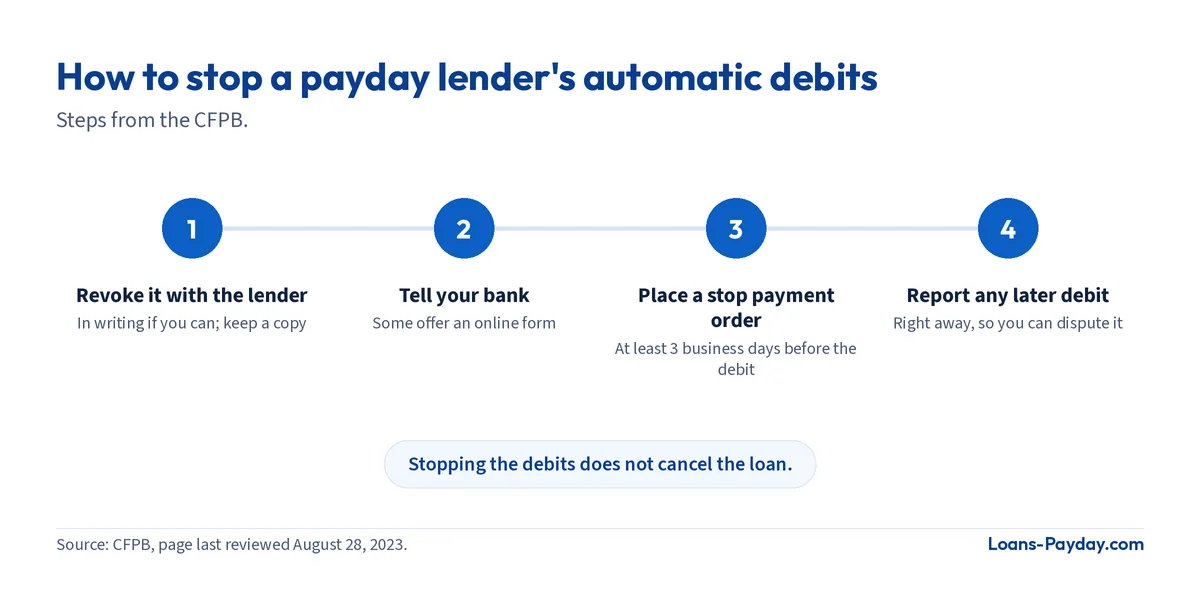
- Tell the lender you are revoking its authorization to take automatic payments. If you do it in writing, keep a copy.
- Tell your bank or credit union that you revoked it. Some offer an online form.
- Place a stop payment order at least three business days before the next scheduled debit. If you place it by phone, the bank may require written confirmation within 14 days, and banks commonly charge a fee.
- Report any debit taken after you revoked authorization right away. Federal law lets you dispute unauthorized transfers if you tell your bank in time.
Stopping the debits does not cancel the loan; you still owe the balance. The steps matter because failed debits get expensive. In an April 2016 report using 18 months of data from 2011 and 2012, the CFPB found that half of online payday and installment borrowers had at least one debit attempt that overdrafted or failed, and those borrowers paid an average of $185 in bank penalty fees. Over the same period, 36% of accounts with a failed debit from an online lender were closed by the bank or credit union. If you already expect to miss a payment, read what happens if you can’t repay a payday loan.
How much does a faxless payday loan cost?
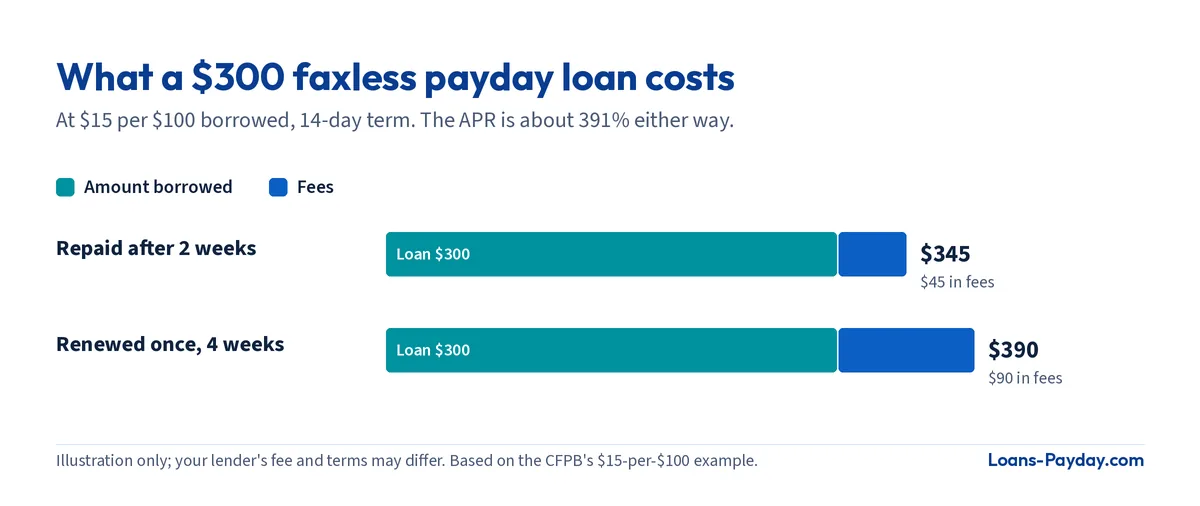
A faxless payday loan costs the same as any payday loan, commonly about $15 for every $100 borrowed. The CFPB says payday fees can range from $10 to $30 per $100 and that $15 per $100 is common, which equals an annual percentage rate (APR) of almost 400% on a two-week loan (page last reviewed November 25, 2024). APR is the yearly cost of a loan, fees included, shown as a percentage. In the CFPB’s example, a $300 loan at $15 per $100 costs $45, so you repay $345. Renew it for two more weeks with another $45 fee, and you have paid $90 to borrow $300 for four weeks while still owing the $300. Where payday loans are allowed, state law sets the maximum fee; see payday loan laws by state.
| Scenario | Amount borrowed | Fees paid | Total paid at payoff | APR |
|---|---|---|---|---|
| Repaid after 2 weeks | $300 | $45 | $345 | About 391% |
| Renewed once, repaid after 4 weeks | $300 | $90 | $390 | About 391% |
Illustration only, based on the CFPB’s $15-per-$100 example and a 14-day term; your lender’s fee and term may differ. APR = (fee ÷ amount) × (365 ÷ days in the term) × 100.
To try other amounts and fees, use the payday loan calculator.
Direct lender or referral service: what is the difference?
A direct lender reviews and funds your loan itself; a referral service passes your request to lenders. With a referral service such as Loans-Payday.com, one form goes to a network of lenders, and any of them may make an offer. Either way, the lender that funds the loan sets the terms, and its agreement is the one you sign. Because a referral can mean more than one company sees your information, read the privacy policy before you submit. Whichever route you choose, check the lender’s license: the CFPB suggests asking your state regulator or attorney general, and notes that in some states a payday loan from an unlicensed business may be void (page last reviewed August 26, 2024).
Red flags: upfront fees, gift cards and approval promises
A lender that wants money before you receive a loan is showing a common sign of a loan scam. The FTC says any upfront fee a lender wants before granting a loan is a cue to walk away, and that banks and other legitimate lenders won’t promise you a loan before you apply (“What To Know About Advance-Fee Loans,” July 2022). With a legitimate payday loan, the fee is part of what you repay on the due date and is written into the agreement. Other warning signs on the FTC’s list:
- A fee for “insurance,” “processing” or “paperwork” before the money arrives.
- A request to pay by gift card, wire transfer or cryptocurrency, which scammers prefer because the money is hard to recover.
- Ads promising credit regardless of your credit history.
- Unsolicited calls that promise you a loan and ask for payment first.
Is a faxless payday loan right for you?
A payday loan may fit a one-time, short gap if you can repay it in full on the due date. It is a poor fit if you would need to renew it, since each renewal adds a new fee, or if you would use it to pay off another loan. Check first whether payday loans are allowed in your state. If you are an active-duty servicemember or a dependent, the Military Lending Act caps the Military Annual Percentage Rate on payday loans and many other kinds of consumer credit at 36% (CFPB, page last reviewed July 27, 2023), so a loan priced near 400% APR cannot legally be made to you at that price. For how lenders treat a weak credit history, see payday loans with bad credit.
Cheaper options to check first
A payday alternative loan (PAL) from a federal credit union is capped at 28% APR, far below typical payday pricing. The National Credit Union Administration (NCUA) confirmed the 28% limit in February 2026 (Letter 26-FCU-02). Under NCUA rules (12 CFR 701.21), a PAL I loan runs from $200 to $1,000 for one to six months and requires at least one month of membership, while a PAL II loan can be up to $2,000 for up to 12 months. The application fee for either is capped at $20. You can also ask the company you owe for a payment plan or ask your employer about a paycheck advance. More options, with costs and catches, are in payday loan alternatives.
Faxless payday loan FAQs
Are faxless payday loans legit?
Yes, a faxless payday loan is an ordinary payday loan applied for and signed online. It is legal only where state law allows payday lending. Check the lender’s state license and walk away from anyone who wants a fee before you get the money.
Do faxless payday loans check your credit?
Lenders may run a soft or hard credit check or use a specialty consumer reporting agency, whether or not you fax anything. The FTC lists ads that promise credit regardless of your credit history as a warning sign of a loan scam.
What do I need for a no-fax payday loan?
Lenders typically ask for proof of identity, regular income, an active checking account and your contact details, all provided online. You may enter details on a form, upload a pay stub or ID, or confirm your bank account electronically.
How fast can I get a faxless payday loan?
Lenders may fund as soon as the next business day, sometimes the same day, but timing is not certain. It depends on the lender, the time you apply, how quickly your details are verified and when your bank posts the deposit.
Updated October 2026. This page is general information, not financial or legal advice.