If you can’t repay a payday loan, the lender will usually still try to pull the money from your bank account, may add late or returned-payment fees, and may offer to renew the loan for another fee. An unpaid loan can go to collections or to court. You can’t be arrested just for not paying.
Maybe the withdrawal is set for Friday, the same morning rent is due. You’ve added it up twice on the back of an envelope, and both times you come out about $200 short.
If that’s where you are, you have a lot of company. The Consumer Financial Protection Bureau (CFPB) found in March 2014 that more than 80 percent of payday loans were rolled over or renewed within two weeks. Coming up short on one says more about a two-week due date than it does about you.
Most people reading this are in one of two places. In the heads-up stage, the due date hasn’t arrived and almost every option is still open. In the clean-up stage, a payment has already bounced or a collector has called. Both have a way through.
Loans-Payday.com is a free referral service, not a lender, and we may be paid by lenders in our network. This page is about handling the loan you already have.

What happens if you can’t pay a payday loan back, step by step?
Most unpaid payday loans move through the same stages: failed withdrawals, fees, renewal offers, collections, and sometimes court. A payday loan is usually a short-term, high-cost loan, generally for $500 or less, that’s typically due on your next payday (CFPB, reviewed May 2024). Lenders usually collect with a post-dated check or an electronic withdrawal you authorized when you took the loan, so the first thing to go wrong is a payment attempt on your bank account (CFPB, reviewed November 2024). The earlier you act, the more choices you keep.
| Stage | What usually happens | What you can do |
|---|---|---|
| Before the due date | Nothing has gone wrong yet. | Ask the lender for an extended payment plan. |
| Due date | The lender cashes your check or withdraws the payment. | Revoke the withdrawal permission in writing; tell your bank at least three business days ahead. |
| Payment fails | Your bank may charge an NSF fee; the lender may add a fee where state law allows and try again. | Call the lender and ask about a plan. |
| Renewal offer | You pay a new fee and still owe the full amount. | Ask for a no-cost payment plan instead. |
| Collections | The lender’s staff or a collection agency contacts you. | Ask for validation information; dispute in writing within 30 days if something looks wrong. |
| Lawsuit | You receive court papers. | Respond by the deadline and contact legal aid. |
| Judgment | The creditor may be allowed to garnish wages or a bank account. | Claim your exemptions; federal benefits have extra protection. |
Based on CFPB consumer guidance. State law can change what a lender may do at each stage.
The lender will usually try to take the payment from your bank account
On the due date, the lender usually cashes your post-dated check or withdraws the payment electronically. If the money isn’t there, two kinds of fees can land at once: your bank may charge a non-sufficient funds (NSF) fee, and the lender may add a late or returned-check fee, depending on state law (CFPB, reviewed November 2024). The lender can also try again. When the CFPB studied 18 months of online payday loan data from 2011 and 2012, half of online borrowers were charged an average of $185 in bank penalties, 70 percent of second payment requests failed, and 36 percent of accounts with a failed debit from an online lender ended up closed (CFPB, April 20, 2016).
Those bank fees are the main reason to act before the next withdrawal.
Can you stop a payday lender from taking money from your account?
Yes, you can withdraw your permission for automatic payments, even if you agreed to them before. The CFPB’s steps: tell the lender you’re revoking its authorization and follow up in writing, tell your bank or credit union the same in writing, and keep copies with dates (CFPB, reviewed August 2026). Some banks also suggest a stop payment order, which usually has a fee. Under federal rules, you can stop a preauthorized electronic payment by telling your bank at least three business days before it’s scheduled; the bank can ask for written confirmation within 14 days (12 CFR 1005.10(c)).
If the lender takes a payment after you’ve told both the lender and your bank, the CFPB says that payment is an error and you can ask your bank for a refund. Stopping the withdrawals doesn’t cancel what you owe, though. It gives you room to call the lender about a plan.
Can you get an extension on a payday loan?
Usually you can, but a rollover and an extended payment plan cost very different amounts. A rollover, also called a renewal, means you pay a new fee to push back the due date while still owing the whole loan. In a CFPB example from April 6, 2022, a borrower with a typical $300 loan pays $45 in rollover fees every two weeks and, after four months, has paid $360 in fees and still owes the $300. An extended payment plan splits what you owe into smaller installments instead. In the same example, taking a no-cost plan at the first rollover would have cost $345 in total.
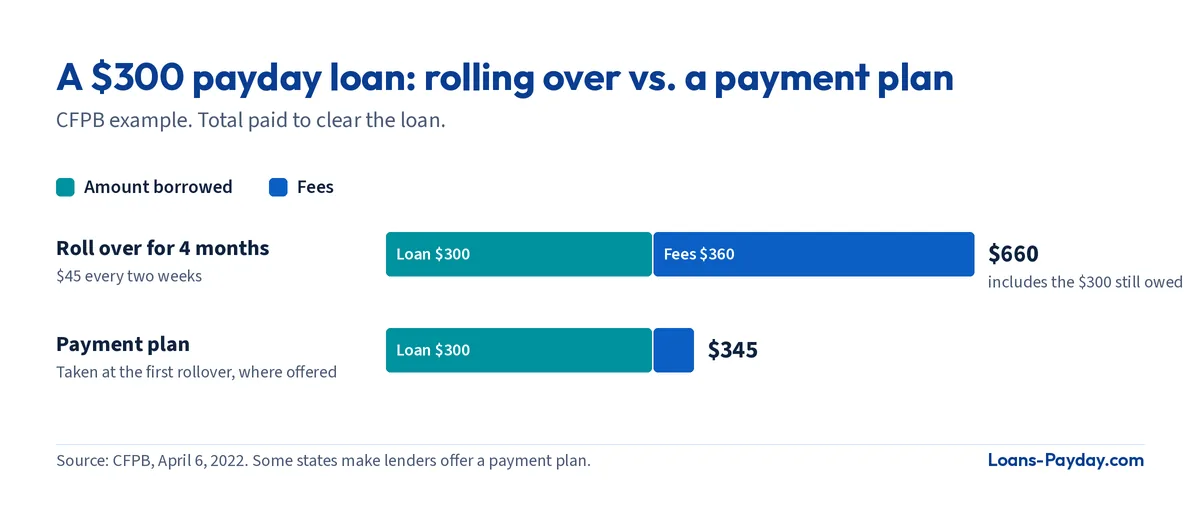
Some states make lenders offer one. In an April 2022 report, the CFPB counted 13 states that require it: Alabama, Alaska, Florida, Idaho, Indiana, Louisiana, Michigan, Nevada, South Carolina, Utah, Washington, Wisconsin and Wyoming. All except Michigan bar a fee for the plan, several require at least four installments, and some limit it to once a year or to borrowers with a certain number of loans. Laws change, so check our payday loan laws by state page or your state regulator. Where a plan isn’t required, you can still ask. To see how repeat fees add up on your own loan, try the payday loan calculator.
What happens when a payday loan goes to collections?
A loan in collections is one the lender has handed to a collection team or agency to recover. The Fair Debt Collection Practices Act (FDCPA) generally covers companies whose main business is collecting debts or that regularly collect debts owed to someone else (15 U.S.C. 1692a(6)), so a lender collecting its own loan in its own name usually falls outside it. Once an outside collector is involved, these federal rules apply:
- The collector has to give you validation information, including the original creditor and an itemized balance, in its first contact or within five days. You then have 30 days to dispute the debt in writing, and the collector has to pause collecting the disputed amount until it responds (CFPB, reviewed January 2024).
- Collectors generally can’t contact you before 8 a.m. or after 9 p.m., and they’re presumed to break the law if they call about a debt more than seven times in seven days (CFPB, reviewed December 2024).
- If you ask a collector in writing to stop all contact, it has to stop, except to say it’s ending contact or to name an action such as a lawsuit (CFPB, reviewed May 2024). The debt itself stays.
A collector can also report negative information to a credit reporting company, and most negative information can stay on your report for seven years (CFPB, reviewed September 2026).
Can a payday lender call your work or tell your employer?
A debt collector may not tell your employer that you owe a debt, though it can contact your employer to find your address or phone number (CFPB, reviewed December 2024). If your job doesn’t allow personal calls, tell the collector, and it isn’t allowed to call you there. A lender calling about its own loan may fall outside these federal limits, but some states have collection laws that reach lenders too.
Can a payday lender sue you or garnish your wages?
Yes, a lender or collector can sue, but garnishment generally needs a court judgment first. Wage garnishment means your employer is ordered to hold back part of your pay to cover a debt. “Most creditors can only garnish wages or benefits after a court issues a judgment saying that you owe the debt,” the CFPB says (reviewed August 2023). If you get court papers, respond by the deadline; responding doesn’t mean you admit you owe the amount. If you don’t, the court can enter a default judgment, which the CFPB says can be very difficult to change or set aside.
Federal law caps wage garnishment for ordinary debts at the lesser of 25 percent of your disposable earnings or the amount by which weekly disposable earnings exceed 30 times the federal minimum wage (U.S. Department of Labor, Fact Sheet #30, December 2024). Your state may protect more. Legal aid offices and clinics may help for free if you qualify, and servicemembers can contact their JAG office.
Your federal benefits have extra protection
Banks have to protect two months of federal benefits deposited directly into your account. Under a Treasury rule, 31 CFR Part 212, a bank that receives a garnishment order generally has two business days to review the account and has to protect the lesser of your balance or the benefits deposited in the previous two months. It covers benefits paid by the Social Security Administration, the Department of Veterans Affairs, the Office of Personnel Management and the Railroad Retirement Board. If you deposit benefits by check, the CFPB says you may also claim the exemption for up to two months’ worth, but you’ll need to raise it yourself.
Can you go to jail for not paying a payday loan?
No, you can’t be arrested for defaulting on a payday loan (CFPB, reviewed August 2024). Jail only enters the picture if you’re sued and then ignore a court order, such as an order to appear; a judge can issue a warrant for that, so go to court if you’re told to. Collectors also can’t threaten to have you arrested, which the CFPB calls a violation of the FDCPA. If a lender threatens arrest, report it to your state attorney general and state regulator, or to the CFPB.
The loan is a bill. It isn’t a crime.
Texas and “hot check” threats
In Texas, payday loans are often obtained through a credit access business, a licensed broker that gets the loan for you from a third-party lender (Texas OCCC). Under Texas Finance Code 393.201(c)(3), these businesses’ contracts have to state that a person may not threaten or pursue criminal charges over a check or debit authorization unless there’s forgery, fraud, theft or other criminal conduct. In an October 14, 2013 bulletin, the Texas Office of Consumer Credit Commissioner (OCCC) said a bounced post-dated check is not, by itself, evidence of a crime. You can file a complaint with the OCCC online.
How to spot a fake debt collector
A caller who threatens arrest is breaking the rules and may not be a real collector at all. The Federal Trade Commission (FTC) advises against sharing personal or financial information until you’ve received validation information. If a call feels wrong, hang up, look up your lender’s number yourself, and report suspected scams at ReportFraud.ftc.gov.
How do you get out of payday loan debt?
The cheapest ways out usually start with your lender, a nonprofit counselor or a credit union. They’re listed roughly in the order to try them, since each one costs more, or asks more of you, than the one before.

- Ask the lender for an extended payment plan. In most states that require one, it costs nothing extra.
- Talk to a nonprofit credit counselor. The National Foundation for Credit Counseling (NFCC) is a nonprofit network of counseling agencies. A counselor may suggest a debt management plan, where you make one monthly deposit and the agency pays your unsecured creditors. The FTC says these plans can take 48 months or more and that nonprofit status doesn’t mean a service is free, so ask about fees first.
- Replace it with a credit union payday alternative loan (PAL). A PAL is a small federal credit union loan with federal limits on its cost. PAL I loans run $200 to $1,000 for one to six months, after at least a month of membership; PAL II loans go up to $2,000 for one to 12 months. Both cap the application fee at $20 and can’t be rolled over (12 CFR 701.21), and the NCUA confirmed in February 2026 that the rate can go up to 28 percent. Not every credit union offers them.
- Ask your other bills for time. A short payment arrangement with a utility or phone company can free up cash for the payday loan.
- Consider debt settlement only with care. The FTC says settlement companies can’t charge fees before they settle a debt, creditors don’t have to agree, your credit can suffer while you stop paying, and forgiven debt may be taxable. A company selling “payday loan consolidation” that tells you to stop paying your lenders and pay it instead is offering settlement.
- Keep bankruptcy for last. It’s covered below.
One option to skip is a new payday loan to pay off the old one. That’s a new fee on the same money, which is how rollover costs build. If you do need to borrow, our payday loan alternatives guide lists options that usually cost less.
| Option | What it costs | How long it takes | Main catch |
|---|---|---|---|
| Extended payment plan | No fee in most states that require one (Michigan allows a fee) | Set by state law; many require at least four installments | Not offered everywhere |
| Debt management plan | Ask the agency; nonprofit doesn’t mean free | Can take 48 months or more | Needs every payment on time |
| Credit union PAL | Up to 28% interest; application fee up to $20 | 1 to 6 months (PAL I) or 1 to 12 months (PAL II) | Membership needed; not offered everywhere |
| Debt settlement | Company fees after settlement; possible tax on forgiven debt | Varies | Credit damage; creditors may refuse |
| Bankruptcy | Court and attorney costs | Chapter 13 plans run three to five years | Can stay on your credit report up to 10 years |
Sources: CFPB, FTC, 12 CFR 701.21 and NCUA (February 2026). Terms vary by state and provider.
Can payday loans be included in bankruptcy?
Payday loans can usually be wiped out in a bankruptcy. A discharge releases you from most debts, and payday loans aren’t among the exceptions the Bankruptcy Code lists. Filing also starts an automatic stay, during which creditors generally can’t start or continue lawsuits, wage garnishments or even phone calls demanding payment (U.S. Courts). A lender can ask the court to keep a debt it says you took on through false pretenses or fraud (11 U.S.C. 523(a)(2)(A)), so tell your attorney about any recent loans.
Bankruptcy’s effects last. You need credit counseling from an approved agency within 180 days before filing (U.S. Courts), a bankruptcy can stay on your credit report for up to 10 years (CFPB), and Chapter 13 means a court-approved repayment plan over three to five years (FTC). If payday loans are part of a bigger pile of debt, legal aid or a bankruptcy attorney can tell you whether it’s worth considering.
Extra protection if you’re in the military
Active-duty servicemembers and covered dependents can’t be charged more than 36 percent on most consumer loans. That cap comes from the Military Lending Act and is measured as a Military Annual Percentage Rate that counts finance charges, credit insurance and certain other fees (CFPB, reviewed January 2024). Lenders also can’t require a military allotment or mandatory arbitration. Your installation’s legal assistance (JAG) office or financial readiness office can help.
How do you report a payday lender or debt collector?
You can file a complaint with the CFPB online or by phone at (855) 411-2372. The CFPB sends your complaint to the company, and most companies respond within 15 days (CFPB, “Submit a complaint”). You can also complain to your state’s financial regulator or attorney general; our state law guide links to each regulator.
Your one step for today
Call your lender before the next withdrawal and ask for an extended payment plan. Use plain words: “I can’t make the full payment on [date]. Do you offer an extended payment plan, and does my state require one?” Write down who you spoke with and what they said. You don’t have to explain why money is tight or have the whole budget figured out first. If the due date has already passed, make the same call.
That’s enough for today. If the answer is no, a nonprofit credit counselor or your local credit union is tomorrow’s step. Once the pressure is off, you can read more about how payday loans work.
Payday loan repayment FAQs
Will an unpaid payday loan hurt my credit?
It can once the loan goes to collections. A collector can report negative information to a credit reporting company, and most negative information can stay on your report for seven years (CFPB). A payment plan you keep up with can stop the loan from reaching that point.
Can a payday lender take money after I revoke permission?
It isn’t supposed to. Once you’ve told both the lender and your bank, the CFPB says any further payments the lender starts are errors, and you can ask your bank for a refund.
What happens if you don’t pay a payday loan in Texas?
The same stages apply: withdrawal attempts, fees, collections and possibly a lawsuit. Texas adds a specific protection: a credit access business can’t threaten or pursue criminal charges over a bounced check or debit authorization unless there’s forgery, fraud, theft or other criminal conduct (Texas OCCC, October 2013).
Does an unpaid payday loan ever go away?
Not on its own, but there’s a time limit on lawsuits. After your state’s statute of limitations runs out, the debt is “time-barred” and collectors can’t sue you over it, though in some states they can still contact you (FTC). In some states a partial payment or written acknowledgment restarts the clock, so check before paying on an old debt.
Is payday loan consolidation a good idea?
It depends on what’s being offered. A credit union PAL or a nonprofit debt management plan can lower what you pay. A company that tells you to stop paying your lenders and pay it instead is selling debt settlement, which carries the risks described above.
Updated October 2026. This page is general information, not financial or legal advice.