To qualify for a payday loan, you generally need to be at least 18, show valid ID, prove regular income from a job or another source, and have an active bank, credit union or prepaid card account, according to the Consumer Financial Protection Bureau (CFPB). Your state’s law and your military status can also decide whether a lender is allowed to lend to you.
This guide explains the payday loan requirements lenders use, how they check them and what to do if you don’t qualify. Loans-Payday.com is a free referral service, not a lender; we may be paid by lenders in our network. Each lender sets its own criteria and makes its own decision.
What are the basic requirements for a payday loan?
Most payday lenders ask for proof of age, identity, income and a bank account. The CFPB’s answer to “What do I need to qualify for a payday loan?” (last reviewed August 26, 2024) says lenders generally require an active bank, credit union or prepaid card account; proof or verification of income from a job or other source; and valid identification, with a minimum age of 18. Lenders also need a phone number and email address where they can reach you, and many ask for your Social Security number to confirm your identity. One requirement is out of your hands: the loan has to be legal in the state where you live.
To send a request through Loans-Payday.com, you need to be 18 or older, live in the US, have regular income and have a checking account. Lenders in the network may add eligibility rules of their own, such as a higher minimum income.
What should you have ready before you apply?
Have your ID, income records and bank details on hand so you can answer a lender’s questions accurately. Being prepared does not guarantee an offer. The table lists the usual payday loan qualifications and how a lender may check each one.
| Requirement | What lenders usually ask for | How it may be checked |
|---|---|---|
| Age | At least 18 (CFPB) | Date of birth on your ID |
| Identity | Government-issued photo ID; often your Social Security number | ID details compared with your application and other records |
| Income | Recent pay stubs, benefit statements or bank deposits showing regular income | Documents you upload, bank statements or a call to your employer |
| Account | An active bank, credit union or prepaid card account in your name | Routing and account numbers; some lenders confirm the account electronically |
| Contact details | Phone number, email address, home address | A call, text or email from the lender |
| State of residence | An address in a state where payday loans are legal and the lender is licensed | Address on your ID and application |
| Military status | Whether you are covered by the Military Lending Act | Defense Department database or a credit report indicator (32 CFR 232.5) |
| Open payday loans | Whether you already have a payday loan outstanding | A state database in some states, including Florida, Michigan and Washington |
General information only. Requirements vary by lender and by state.
Qualifying for a payday loan does not mean you can afford one
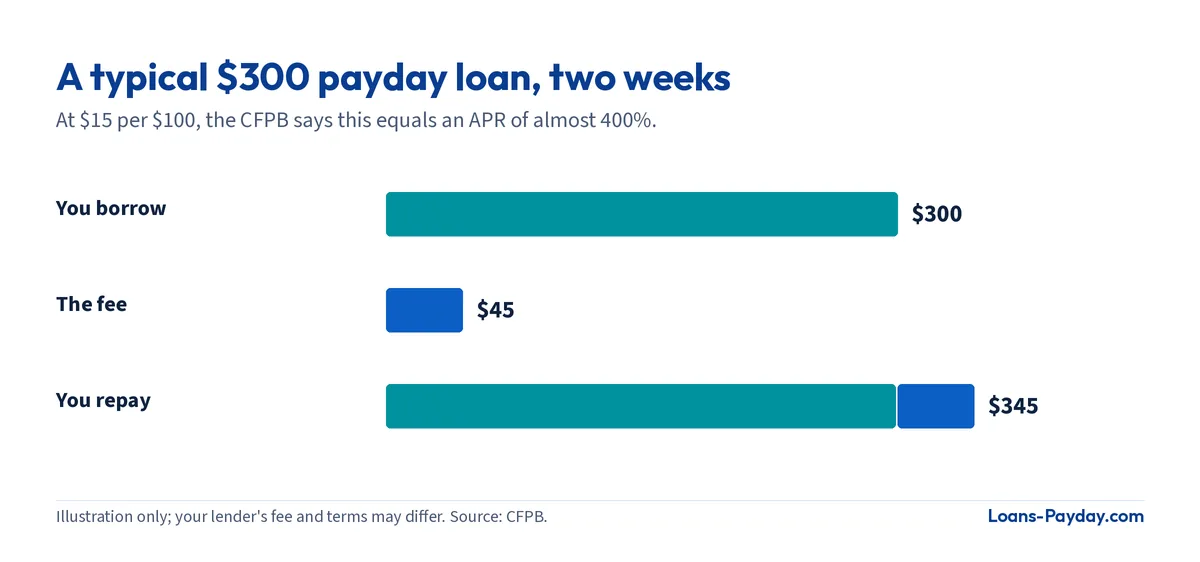
Payday loan requirements are easy to meet because lenders generally don’t check whether you can repay. The CFPB states that “payday lenders do not generally verify your ability to repay the loan” (What is a payday loan?, last reviewed May 28, 2024). The price is the catch. Fees range from $10 to $30 per $100 borrowed depending on state law, and a $15-per-$100 charge is common, which works out to an annual percentage rate (APR) of almost 400% on a two-week loan, according to the CFPB (last reviewed November 25, 2024). At that fee, a $300 loan costs $45 for two weeks, so $345 is due on your next payday (illustration only; your lender’s fee may differ). You can try other amounts in the payday loan calculator.
A referral request is not the same as applying at one store. Your information goes to a network of possible lenders. The CFPB warns that lead generators may not find you the cheapest loan and that other lenders or service providers may contact you after you apply, so compare the APR and total repayment of any offer before you sign. How payday loans work walks through the process from request to repayment.
How do lenders verify what you tell them?
Lenders confirm your identity, income and bank account before they make an offer.
Identity and age
Expect to give your full name, date of birth, home address and the number on a government-issued photo ID. The Defense Department database that lenders may use to check Military Lending Act status needs your last name, date of birth and Social Security number, under federal rule 32 CFR 232.5.
Income
Lenders want to see money arriving on a regular schedule, because the loan comes due when your next paycheck or benefit payment lands. The CFPB says lenders accept income “from a job or other source,” and that payday loans are usually due on your next payday or when other income, such as a pension or Social Security, arrives. Some lenders call your employer to confirm that you still work there and what you earn.
Bank account
The lender deposits the loan into this account and collects repayment from it. The CFPB notes that online lenders may not take a check and may ask you to authorize automatic electronic payments instead. Before you agree, the CFPB suggests making sure the lender’s street address, phone number and email address are easy to find, since you may need to reach the lender later to cancel those payments.
Do payday lenders check your credit?
Payday lenders may check your credit, a specialty database that tracks short-term loans, or both. The CFPB says some online lenders pull a credit report before lending. That check may be a soft inquiry, which does not affect your credit scores, or a hard inquiry, which does, according to the CFPB (What is a credit inquiry?, last reviewed September 5, 2025). Even so, the CFPB says that, unlike other lenders, payday lenders generally don’t use your credit reports or scores to decide whether you’re eligible, although some use information from specialty credit reporting companies (Can taking out a payday loan help rebuild my credit or improve my credit score?, last reviewed November 25, 2024).
Specialty consumer reporting agencies collect particular kinds of consumer history, such as bank account use or repayment history for a specific product or service, according to the CFPB. Its list of consumer reporting companies (current as of January 2025) names several that serve payday lenders: Clarity Services (owned by Experian), FactorTrust (owned by TransUnion), and DataX and Teletrack (both owned by Equifax). You can use that list to request your file from each company. If your credit is weak, payday loans with bad credit covers what lenders look at and what it costs.
What can stop you from qualifying?
Your state, your military status, an open payday loan or too little income can each end an application.
Where you live
State law decides whether payday loans are allowed and on what terms. New York’s Department of Financial Services has stated that “payday loans are illegal in New York under both civil and criminal usury statutes” (February 22, 2013). Other states allow payday loans but cap the amount, the fee or the number of loans. The CFPB adds that you may have more consumer protections if the lender is required to be licensed in your state. See payday loan laws by state for the rules where you live.
Active-duty military and family members
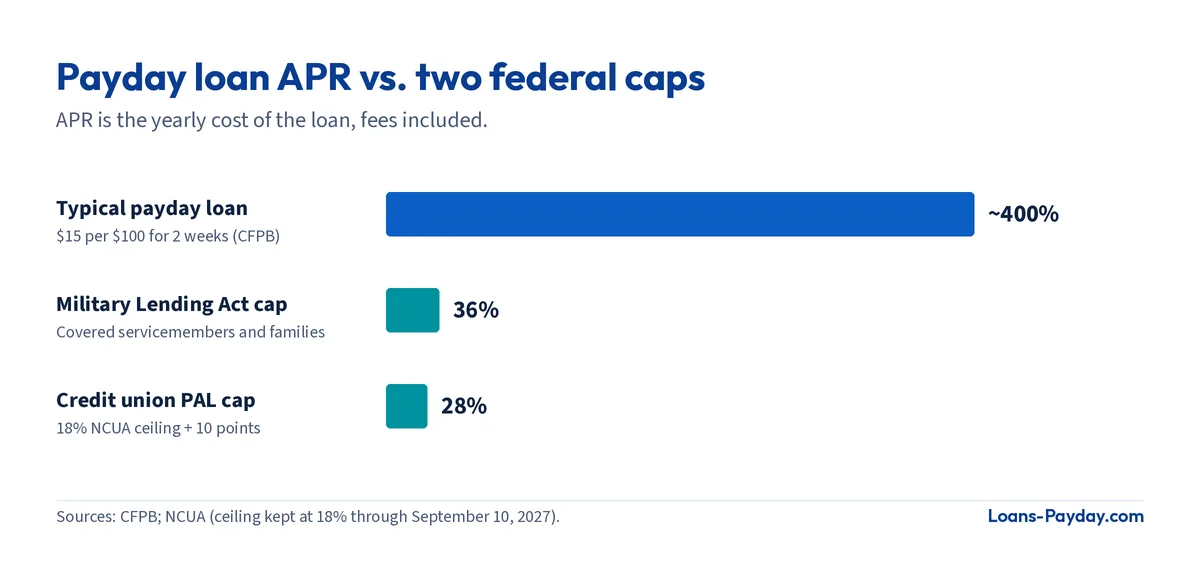
The Military Lending Act caps most consumer credit for covered borrowers at a 36% Military Annual Percentage Rate (MAPR). The MAPR counts finance charges and certain other fees, and payday loans are covered, according to the CFPB (page last modified September 8, 2025). Covered borrowers include active-duty servicemembers, Reserve members on active duty, National Guard members mobilized under federal orders for more than 30 consecutive days, spouses and, in some cases, dependents. A lender whose loans cost more than 36% cannot make that loan to a covered borrower, and federal rules let lenders check your status in the Defense Department database.
An open payday loan or a state loan limit
Several states use a central database to enforce payday borrowing limits. In Florida, a lender may not make a payday loan, called a deferred presentment transaction, to someone who already has one outstanding or whose last one ended less than 24 hours earlier, and it must check the state database first (Florida Statutes section 560.404, 2025). Michigan allows two open transactions at once, but only one at any single licensed location, and every transaction goes into a state database (Michigan Department of Insurance and Financial Services, updated September 4, 2025). Washington limits borrowers to eight payday loans in any 12-month period and tracks each loan in a statewide database, according to its Department of Financial Institutions.
Income that doesn’t support the amount
Lenders size the loan to your income, and some states set the limit by law. Washington caps a payday loan at $700 or 30% of your gross monthly income, whichever is less. Requests through Loans-Payday.com range from $100 to $2,500; the amount a lender offers depends on the lender, your income and your state’s law.
Who uses payday loans, and why?
Most payday borrowers use the money for regular bills rather than one-time emergencies, according to Pew research. A July 2012 report by The Pew Charitable Trusts, based mainly on 2010 data, found that 12 million American adults used payday loans each year, and the average borrower took out eight loans of $375 and spent $520 on interest. The most common reason for a first payday loan was a recurring expense such as utilities, a credit card bill, rent, a mortgage payment or food (69% of borrowers). Another 16% paid for an unexpected expense, such as a car repair or an emergency medical bill.
Many households still lack a cash cushion for a small surprise. In the Federal Reserve’s survey of household finances in 2025 (published May 2026), 63% of adults said they would cover a $400 emergency expense entirely with cash or its equivalent. When Pew asked borrowers what they would do without payday loans, 81% said they would cut back on expenses and 44% said they would borrow from a bank or credit union.
What can you do if you don’t qualify?
If a lender declines you, a credit union loan or a payment plan with the company you owe may cost far less. Federal credit unions offer payday alternative loans (PALs), small loans regulated by the National Credit Union Administration (NCUA). Under NCUA rule 12 CFR 701.21, a PAL I runs from $200 to $1,000 for one to six months and requires at least one month of membership, while a PAL II goes up to $2,000 for one to 12 months. The application fee is capped at $20. The rate can be up to 10 percentage points above the federal credit union ceiling, which the NCUA kept at 18% through September 10, 2027 (press release, February 6, 2026), so PALs top out at 28%.
You can also ask the utility, landlord or other creditor for a payment plan or a later due date, or talk to a nonprofit credit counselor. Don’t take a payday loan to pay off another one; that adds a second fee and leaves the shortfall in place. Payday loan alternatives compares these options, and what happens if you can’t repay a payday loan explains your rights if a loan is already overdue.
Payday loan requirements FAQs
Can I get a payday loan without a job?
You may, if you have regular income from another source. The CFPB says lenders generally require proof of income “from a job or other source,” and payday loans may come due when income such as a pension or Social Security arrives. Each lender decides which kinds of income it accepts.
How old do you have to be to get a payday loan?
You generally must be at least 18, according to the CFPB. A lender can set a higher minimum age, and your ID has to show your date of birth.
Can I qualify for a payday loan with bad credit?
Some payday lenders lend to people with low credit scores, but a lender may still check your credit report or a specialty agency such as Clarity Services or FactorTrust.
Do I need a checking account?
You need an account the lender can pay into and collect from. The CFPB lists an active bank, credit union or prepaid card account as a general requirement. Requests through Loans-Payday.com ask for a checking account.
Does meeting the requirements guarantee a loan?
No. Meeting the basic requirements only means a lender may consider your request. Loans-Payday.com does not make credit decisions, and submitting a request does not guarantee an offer.
Updated October 2026. This page is general information, not financial or legal advice.