Payday loan laws differ by state. Some states license payday lenders and limit the loan amount, fee, term and number of rollovers. Others ban payday loans outright or cap rates low enough that payday lenders don’t operate there. The table on this page lists the current rules for all 50 states and the District of Columbia.
Loans-Payday.com is a free referral service, not a lender; we may be paid by lenders in our network. This page describes state law only. It does not say where any lender operates.
Are payday loans legal in every state?
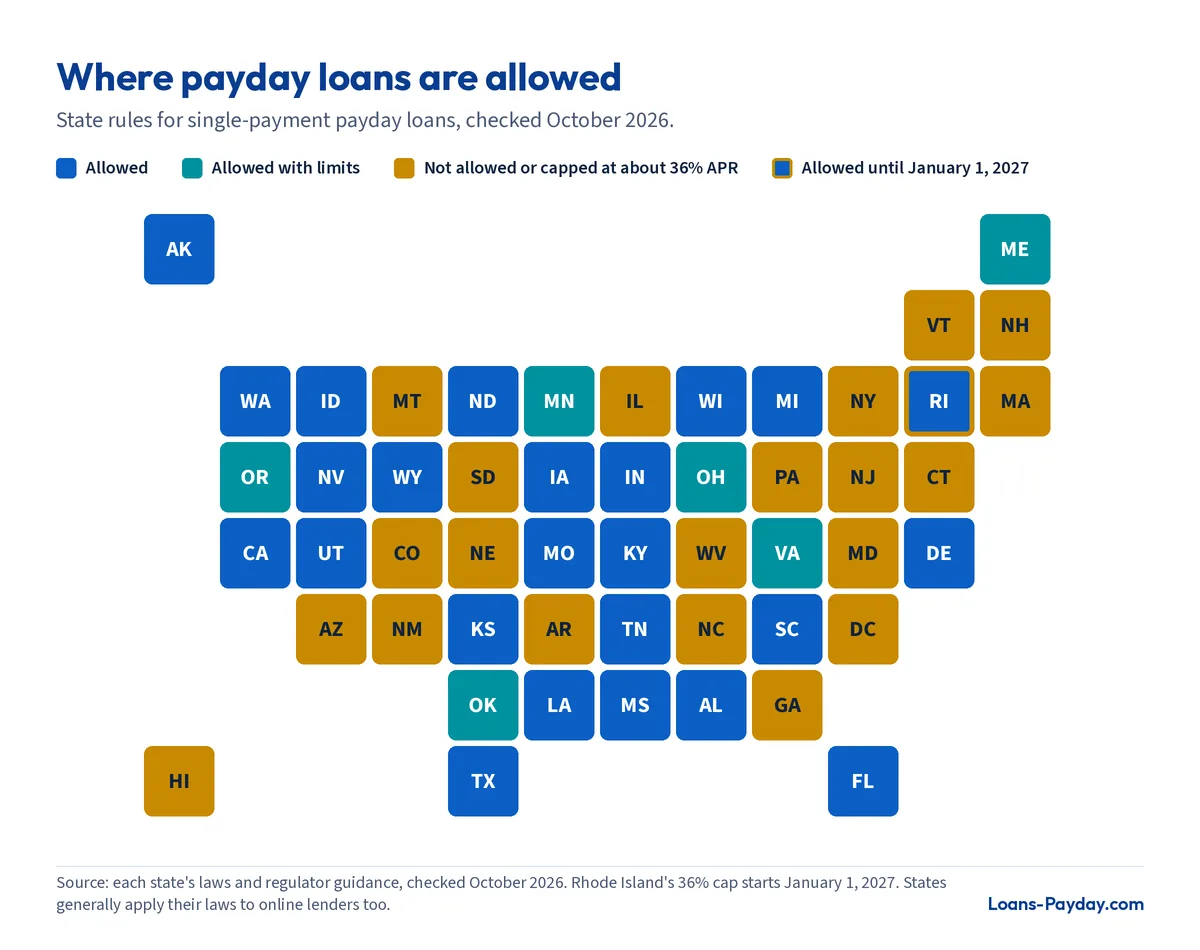
No, payday loans are not legal in every state, and the rules differ widely where they are. The Consumer Financial Protection Bureau (CFPB) notes that “some states do not have payday lending because the loans are not permitted by the state’s law” (CFPB, “What is a payday loan?”, last reviewed May 28, 2024). The Center for Responsible Lending (CRL) described Rhode Island as the 21st state, alongside the District of Columbia, to prohibit triple-digit-rate credit when Rhode Island’s governor signed its reform into law (CRL, July 9, 2025). Rhode Island’s change does not take effect until January 1, 2027. Until then, licensed payday lending continues there.
How do states regulate payday loans?
States regulate payday loans by licensing lenders and limiting the fee, the loan size, the term and repeat borrowing.
Fee and rate caps
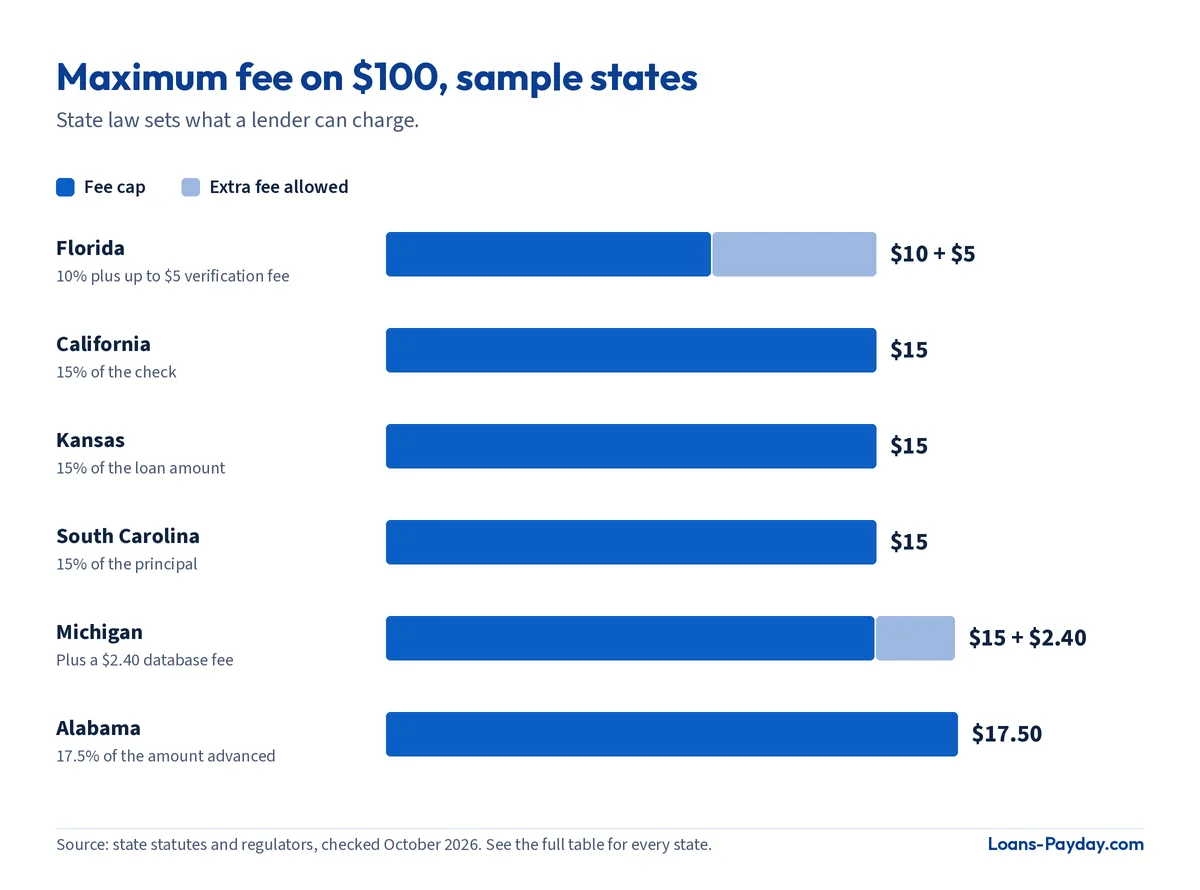
A rate cap is a legal maximum on what a lender can charge, often stated as an annual percentage rate (APR), the yearly cost of a loan including fees. States that allow payday loans usually cap the fee per $100 borrowed instead. The CFPB says payday finance charges range from $10 to $30 for every $100 borrowed, depending on state law, and that a common $15-per-$100 fee equals an APR of almost 400% on a two-week loan (CFPB, “What are the costs and fees for a payday loan?”, last reviewed November 25, 2024). States that ban payday lending usually do it with a cap near or below 36% a year. You can see what a fee costs as an APR with the payday loan calculator.
Loan amount and term limits
States cap the loan as a dollar amount, a share of your income, or both. California caps the check at $300 (California DFPI), while Washington limits total payday principal to $700 or 30% of your gross monthly income, whichever is less (RCW 31.45.073). The loan term is the time between borrowing and the due date. Many states set a range, such as 7 to 31 days in Florida (Fla. Stat. § 560.404).
Rollovers, databases and cooling-off periods
A rollover, sometimes called a renewal, means paying a fee to push back the due date without paying down what you borrowed. Many states ban rollovers; others limit them, such as one renewal in Alabama or up to six in Missouri, where each renewal must cut the principal by at least 5% (Mo. Rev. Stat. § 408.500). South Carolina and Michigan require lenders to check a statewide database before lending, so you can’t hold more loans than the law allows. A cooling-off period is a required wait between loans: 24 hours in Florida and seven days in Oregon (ORS 725A.064).
Extended payment plans
An extended payment plan lets you repay a payday loan in installments without new fees when you can’t pay it all on the due date. Florida requires a 60-day grace period at no extra charge if you tell the lender you can’t pay and you complete credit counseling. South Carolina lets you choose a plan of at least four equal installments once every 12 months (S.C. Code § 34-39-280). If you’re already behind, read what happens if you can’t repay a payday loan.
Payday loan laws by state
The table summarizes each state’s payday lending law as of October 2026, with a link to the agency that licenses lenders or enforces the law.
| State | Payday loans allowed? | Max loan amount | Max fee or rate | Loan term | Rollovers | State regulator |
|---|---|---|---|---|---|---|
| Alabama | Allowed | $500 total across all lenders | 17.5% of the amount advanced | 10 to 31 days | 1 renewal; lender may then offer 4 monthly installments | Alabama State Banking Department |
| Alaska | Allowed | $500 | $15 per $100 (or 15%, whichever is less) plus a $5 origination fee | At least 14 days | Up to 2 | Alaska Division of Banking and Securities |
| Arizona | Not allowed or 36% cap | Not applicable | Payday law expired June 30, 2010; consumer loans over 36% a year plus authorized fees are illegal | Not applicable | Not applicable | Arizona Department of Insurance and Financial Institutions |
| Arkansas | Not allowed or 36% cap | Not applicable | 17% a year cap on consumer loans in the state constitution; payday statute repealed in 2011 | Not applicable | Not applicable | Arkansas Attorney General |
| California | Allowed | $300 (check amount) | 15% of the check, $45 on $300 | Up to 31 days | No new loan while one is outstanding; extensions allowed with no added fee | California Department of Financial Protection and Innovation |
| Colorado | Not allowed or 36% cap | $500 | 36% APR (2018 ballot measure) | At least 6 months | 1 renewal | Colorado Attorney General, UCCC |
| Connecticut | Not allowed or 36% cap | Not applicable | Loans of $15,000 or less above 12% a year are void unless made by banks, credit unions or licensed small lenders, which may charge up to 36% APR | Not applicable | Not applicable | Connecticut Department of Banking |
| Delaware | Allowed | $1,000 | No statutory rate cap | Under 60 days | Up to 4; no more than 5 short-term loans in 12 months | Office of the State Bank Commissioner |
| District of Columbia | Not allowed or 36% cap | Not applicable | 24% a year interest cap; licensed check cashers may not advance money on post-dated checks | Not applicable | Not applicable | DC Department of Insurance, Securities and Banking |
| Florida | Allowed | $500 single-payment; $1,000 installment | 10% plus up to $5 verification fee; installment loans 8% of the balance every two weeks | 7 to 31 days; installment 60 to 90 days | Not allowed; 24-hour wait between loans | Florida Office of Financial Regulation |
| Georgia | Not allowed or 36% cap | Not applicable | Payday lending is illegal; loans of $3,000 or less fall under the Georgia Installment Loan Act | Not applicable | Not applicable | Georgia Department of Banking and Finance |
| Hawaii | Not allowed or 36% cap | $1,500 installment loan; one loan at a time | Deferred deposit law repealed in 2021; installment loans capped at 36% a year interest, with total loan charges no more than 50% of the principal | 2 to 12 months (at least 4 months above $500) | 1 renewal | Hawaii Division of Financial Institutions |
| Idaho | Allowed | $1,000 total, and no more than 25% of gross monthly income | No statutory cap | Not set in statute | Up to 3 renewals | Idaho Department of Finance |
| Illinois | Not allowed or 36% cap | Payments due in the first month capped at $1,000 or 25% of gross monthly income, whichever is less | 36% APR cap (Predatory Loan Prevention Act, 2021) | At least 13 days | Not allowed | Illinois Department of Financial and Professional Regulation |
| Indiana | Allowed | $825 or 20% of gross monthly income, whichever is less | 15% of the first $250, 13% of $250.01 to $400, 10% of $400.01 to $825 | At least 14 days | Not allowed | Indiana Department of Financial Institutions |
| Iowa | Allowed | $500 total face value, no more than 2 checks | $15 on the first $100, $10 on each additional $100 | Up to 31 days | Can’t be repaid or refinanced with another check loan from the same lender | Iowa Division of Banking |
| Kansas | Allowed | $500 | 15% of the loan amount | 7 to 30 days | Can’t be repaid with another loan from the same lender; no more than 2 loans at once or 3 in 30 days | Office of the State Bank Commissioner |
| Kentucky | Allowed | $600 total, no more than 2 loans (since July 15, 2026) | $15 per $100 plus a $3 state database fee per loan | 14 to 60 days | Not allowed for a fee | Kentucky Department of Financial Institutions |
| Louisiana | Allowed | $740 outstanding principal (September 1, 2026 to August 31, 2027; adjusted each year) | 16.75% of the check’s face amount plus a $10 documentation fee | Up to 30 days | No renewals or rollovers; a new loan for the balance only after paying the fees plus 25% of the amount advanced | Louisiana Office of Financial Institutions |
| Maine | Allowed with limits | No payday-specific limit; the rate cap steps down above $2,000 | 30% a year on the first $2,000, but minimum charges of $5 to $25 apply | No payday-specific term | Refinancing allowed within the same rate limits, without a second minimum charge | Maine Department of Professional and Financial Regulation |
| Maryland | Not allowed or 36% cap | Not applicable | Consumer loans capped at 2.75% a month on the first $1,000 | Not applicable | Not applicable | Maryland Office of Financial Regulation |
| Massachusetts | Not allowed or 36% cap | Not applicable | 23% a year plus a $20 administrative fee on licensed small loans up to $6,000 | Not applicable | Not applicable | Massachusetts Division of Banks |
| Michigan | Allowed | $600 per loan; no more than 2 open loans, each with a different lender | 15% to 11% per $100 in tiers ($15 on $100, $76 on $600) plus a $2.40 database fee | 7 to 31 days | Not allowed; written extension only within 31 days | Michigan Department of Insurance and Financial Services |
| Minnesota | Allowed with limits | $350 | Up to 50% APR, all fees included; loans above 36% APR require an ability-to-repay check | Up to 30 days, single payment | A new loan can’t repay one from the same lender | Minnesota Department of Commerce |
| Mississippi | Allowed | $500 including fees | $20 per $100 on checks up to $250; $21.95 per $100 on $251 to $500 | Up to 30 days (at least 28 days for $250 to $500) | Not allowed | Mississippi Department of Banking and Consumer Finance |
| Missouri | Allowed | $500 outstanding per lender | Total interest and fees, including renewals, capped at 75% of the initial loan | 14 to 31 days | Up to 6; each must cut principal by at least 5% | Missouri Division of Finance |
| Montana | Not allowed or 36% cap | $300 | 36% a year | Up to 31 days | Not allowed; one loan at a time | Montana Division of Banking and Financial Institutions |
| Nebraska | Not allowed or 36% cap | $500 total, no more than 2 checks | 36% APR (2020 ballot initiative) | Up to 34 days | Not allowed; no-fee extension within 34 days | Nebraska Department of Banking and Finance |
| Nevada | Allowed | 25% of expected gross monthly income | No statutory fee cap | Up to 35 days | Allowed; repayment can’t be extended past 90 days from the loan date | Nevada Financial Institutions Division |
| New Hampshire | Not allowed or 36% cap | $500 | 36% APR | 7 to 30 days | Not allowed | New Hampshire Banking Department |
| New Jersey | Not allowed or 36% cap | Not applicable | Criminal usury limit of 30% a year for individual borrowers | Not applicable | Not applicable | New Jersey Department of Banking and Insurance |
| New Mexico | Not allowed or 36% cap | Not applicable | 36% APR cap (2022 law, in effect January 1, 2023) | Loans under 120 days not allowed; at least 4 equal payments | Not applicable | New Mexico Financial Institutions Division |
| New York | Not allowed or 36% cap | Not applicable | Civil usury limit 16% a year; criminal usury limit 25% | Not applicable | Not applicable | New York Department of Financial Services |
| North Carolina | Not allowed or 36% cap | Not applicable | Payday statute expired; licensed consumer loans capped at 33% a year on the first $4,000 | Not applicable | Not applicable | North Carolina Commissioner of Banks |
| North Dakota | Allowed | $500 per loan; no more than $600 owed across all lenders | 20% of the amount advanced; a renewal fee of up to 20% of the amount renewed | Up to 60 days including one renewal; a renewal period must be at least 15 days | 1 renewal; 3-business-day wait between loans | North Dakota Department of Financial Institutions |
| Ohio | Allowed with limits | $1,000 | 28% a year plus a monthly fee of 10% of the loan or $30, whichever is less | 91 days to 1 year; shorter only if payments stay within 6% of gross or 7% of net monthly income | No new loan while one with the same lender is outstanding, except a refinance without the monthly fee; $2,500 total across lenders | Ohio Division of Financial Institutions |
| Oklahoma | Allowed with limits | $1,824.60 in small loans across all lenders (from July 1, 2025); monthly payments no more than 20% of gross monthly income | Interest up to 17% a month | 60 days to 12 months, in equal payments; new deferred deposit (payday) loans ended August 1, 2020 | Not applicable: small loans must be repaid in equal payments over 60 days to 12 months | Oklahoma Department of Consumer Credit |
| Oregon | Allowed with limits | 25% of net monthly income if you earn $60,000 a year or less | 36% a year plus a one-time origination fee of $10 per $100, up to $30 | 31 to 60 days | Up to 2 renewals; 7-day wait between loans | Oregon Division of Financial Regulation |
| Pennsylvania | Not allowed or 36% cap | Not applicable | Usury caps below 36% APR | Not applicable | Not applicable | Pennsylvania Department of Banking and Securities |
| Rhode Island | Allowed until January 1, 2027 | $500 | 10% of the amount advanced | At least 13 days | 1 | Rhode Island Department of Business Regulation |
| South Carolina | Allowed | $550 | 15% of the principal | Up to 31 days | Not allowed; one loan at a time, checked against a state database | South Carolina Consumer Finance Division |
| South Dakota | Not allowed or 36% cap | $500 | 36% a year | Up to 6 months | Up to 4; each must cut principal by at least 10% | South Dakota Division of Banking |
| Tennessee | Allowed | $500 total, no more than 2 checks | 15% of the face amount of the check | Up to 31 days | Not allowed | Tennessee Department of Financial Institutions |
| Texas | Allowed | No state limit; cities with payday ordinances, such as Fort Worth, cap it at 20% of gross monthly income | No state cap on credit access business fees | At least 7 days for state-licensed lenders; no state maximum | No state limit; lenders must disclose what renewing costs. Cities with payday ordinances, such as Fort Worth, allow 3 refinances, each repaying at least 25% of the principal | Texas Office of Consumer Credit Commissioner |
| Utah | Allowed | No statutory limit; lender must ask about your ability to repay | No statutory cap | Up to 10 weeks from the first loan | Allowed within the 10 weeks | Utah Department of Financial Institutions |
| Vermont | Not allowed or 36% cap | Not applicable | 24% a year on the first $1,000 of an installment loan; 18% on single-payment loans | Not applicable | Not applicable | Vermont Department of Financial Regulation |
| Virginia | Allowed with limits | $2,500 | 36% simple interest plus a monthly fee of 8% of the loan or $25, whichever is less | 4 to 24 months; shorter only if payments stay within 5% of gross or 6% of net monthly income | Not allowed; one loan at a time | Virginia State Corporation Commission |
| Washington | Allowed | $700 or 30% of gross monthly income, whichever is less | 15% of the first $500, 10% above $500 | Up to 45 days | No fee for extensions; no more than 8 loans in 12 months | Washington Department of Financial Institutions |
| West Virginia | Not allowed or 36% cap | Not applicable | Consumer loans of $3,500 or less capped at 31% a year | Not applicable | Not applicable | West Virginia Division of Financial Institutions |
| Wisconsin | Allowed | $1,500 or 35% of gross monthly income, whichever is less, including interest and fees | No statutory cap before the due date; 2.75% a month after it | Up to 90 days | A loan can be repaid with one new payday loan, but that loan can’t be repaid with another | Wisconsin Department of Financial Institutions |
| Wyoming | Allowed | No statutory limit | $30 or 20% a month, whichever is greater | Up to 1 calendar month | Not allowed; a loan can’t be repaid with a new one from the same lender | Wyoming Division of Banking |
“Allowed” means the state licenses single-payment payday (deferred deposit) loans. “Allowed with limits” means the state permits short-term lending only in a restricted form, such as longer installment terms or lower rate caps. “Not allowed or 36% cap” means payday lending is banned or limited to about 36% a year or less. Limits apply to single-payment loans unless noted. Laws change, so confirm the rules with your regulator before you borrow.
Which states have changed their payday loan laws recently?
Rhode Island is the next scheduled change: its deferred deposit law is repealed effective January 1, 2027. The state’s code lists § 19-14.4-5.1, the section that authorizes deferred deposits, as repealed on that date. The Rhode Island General Assembly said on July 2, 2025 that the law (2025-H 5042A and 2025-S 0229A) removes the exemption that let payday lenders register as deferred deposit providers, or “check cashers,” and charge an effective 260% APR. CRL describes the result as a 36% APR limit. Until January 1, 2027, the limits in the table apply.
Alaska kept its current law after a reform attempt failed. The legislature passed Senate Bill 39 in 2025 to cap payday loan rates at 36%, and Governor Mike Dunleavy vetoed it in June 2025 (Alaska Public Media, June 26, 2025; LegiScan bill history).
Minnesota’s 2023 law lets lenders charge up to 50% APR with every fee included and requires an ability-to-repay check on any loan above 36% APR (Minn. Stat. §§ 47.60 and 47.603). The Consumer Federation of America (CFA) reports 36% caps adopted in Colorado (2018), Nebraska (2020), Illinois and Hawaii (2021) and New Mexico (2023). New Mexico’s law was signed in 2022 and took effect January 1, 2023 (HB 132, 2022). Oklahoma replaced deferred deposit loans with installment loans under its Small Lenders Act; the Oklahoma Department of Consumer Credit said no new deferred deposit loans could be made after August 1, 2020. Michigan raised its database verification fee to $2.40 on September 1, 2025 (Michigan DIFS).
Do state payday loan laws apply to online lenders?
Yes, states generally apply their lending laws to online loans made to their residents. New York’s Department of Financial Services said in 2013 that payday lending “is illegal in New York under both civil and criminal usury statutes” and sent cease-and-desist letters to online lenders. New Jersey’s Department of Banking and Insurance said the same year that payday terms offered by unlicensed out-of-state or foreign lenders violate the state’s usury limits.
Some lenders tied to Native American tribes claim state law doesn’t apply to them. The Georgia Attorney General’s office says tribal immunity is not a defense to payday lending in Georgia, citing a 2016 Georgia Supreme Court decision, Western Sky Financial v. State of Georgia.
How can you check whether a payday lender is licensed?
You can check a lender’s license with your state regulator, listed in the table above. The CFPB suggests contacting your state regulator or attorney general if you have questions about payday lending where you live (CFPB, May 28, 2024).

- Find your state’s regulator in the table and open its website.
- Search the regulator’s licensee list for the lender’s exact legal name. California’s DFPI and the Texas OCCC both offer online license searches.
- Compare the licensed name with the name on the lender’s website and loan agreement. A mismatch is a reason to stop.
- If the lender isn’t licensed where your state requires it, don’t sign, and consider reporting it to the regulator or attorney general.
How does the Military Lending Act limit payday loans?
The Military Lending Act caps most consumer loans to active-duty servicemembers and their covered dependents at a 36% Military Annual Percentage Rate (MAPR), according to the CFPB (last reviewed January 12, 2024). The MAPR counts finance charges, credit insurance, add-on products and certain fees, not just interest. It applies in every state, including to Guard and Reserve members on active duty. Some states add their own rules; Ohio, for example, bars the monthly maintenance fee for active-duty members and their dependents (Ohio Rev. Code § 1321.40).
What are your options if payday loans aren’t allowed in your state?
If your state bans payday loans, start by asking a credit union about small-dollar loans and asking the company you owe whether it offers a payment plan. Ask before the due date if you can. The guide to payday loan alternatives compares the costs. Never take a payday loan to pay off another loan. For the basics of fees and repayment, see how payday loans work.
If payday loans are legal where you live and you’ve compared the cost, you can send one request through Loans-Payday.com. Lenders in the network decide whether to make an offer, and any offer must follow your state’s rules.
Payday loan laws FAQs
Are payday loans legal in all states?
No. Some states ban payday loans and others cap rates too low for payday lending. The table above shows the status in each state and the District of Columbia.
What states allow payday loans?
As of October 2026, the table marks these states as allowing single-payment payday loans: Alabama, Alaska, California, Delaware, Florida, Idaho, Indiana, Iowa, Kansas, Kentucky, Louisiana, Michigan, Mississippi, Missouri, Nevada, North Dakota, Rhode Island (until January 1, 2027), South Carolina, Tennessee, Texas, Utah, Washington, Wisconsin and Wyoming. Maine, Minnesota, Ohio, Oklahoma, Oregon and Virginia allow short-term loans only in a restricted form, such as longer installment terms or lower rate caps. Check your state’s row and its regulator, because the limits differ.
Are payday loans legal in Georgia?
No. The Georgia Department of Banking and Finance says payday lending is illegal in Georgia (O.C.G.A. § 16-17-2). Loans of $3,000 or less fall under the Georgia Installment Loan Act, and the Georgia Attorney General says a loan that breaks the payday ban is void.
Are payday loans legal in Pennsylvania?
No. Pennsylvania has no payday lending statute, according to the National Conference of State Legislatures (NCSL), and the CFA lists it among the states whose usury caps are below 36% APR.
Are payday loans legal in North Carolina?
No. North Carolina let its payday lending statute expire, according to NCSL. Licensed consumer finance loans are capped at 33% a year on the first $4,000 (N.C. Gen. Stat. § 53-176). In 2019 the North Carolina Attorney General sued an online lender accused of charging 120% to 200% interest.
Are payday loans legal in New York?
No. The New York Department of Financial Services says payday lending is illegal under the state’s civil and criminal usury laws (DFS, August 6, 2013). The civil usury limit is 16% a year, and lending above 25% a year is criminal usury.
Are payday loans legal in Arizona?
No. Arizona’s payday loan law expired on June 30, 2010, and consumer loans with annual interest above 36%, plus authorized fees, became illegal on July 1, 2010 (Arizona Department of Insurance and Financial Institutions).
Are payday loans legal in New Jersey?
No. New Jersey’s Department of Banking and Insurance says payday loan terms violate the state’s civil and criminal usury rates. The criminal usury limit is 30% a year for individual borrowers (NJ DOBI, April 8, 2013).
What are the payday loan laws in Texas?
Payday loans are legal in Texas through credit access businesses, which arrange loans from third-party lenders and charge a fee for it (Texas OCCC). Texas sets no state cap on those fees, and loan terms run 7 to 180 days (CFA). Some cities add their own limits.
What are the payday loan laws in Florida?
Florida allows single-payment payday loans of up to $500 for 7 to 31 days, with fees capped at 10% plus a verification fee of up to $5 (Fla. Stat. §§ 560.404 and 560.309). Rollovers are banned and you can have one loan at a time.
What are the payday loan laws in California?
California caps a payday check at $300, with a fee of up to 15%, or $45 on a $300 check, and a term of up to 31 days. A lender can’t make a new loan while one is outstanding (California DFPI).
What are the payday loan laws in Michigan?
Michigan allows payday loans of up to $600 for 7 to 31 days. Fees run from 15% on the first $100 down to 11% on higher amounts, plus a $2.40 database fee, and you can have only two open loans, each with a different lender (Michigan DIFS, September 4, 2025).
The table is based on each state’s laws and regulator guidance, checked October 2026. Updated October 2026. This page is general information, not financial or legal advice.