An installment loan is a loan you repay in a set number of scheduled payments, usually monthly or every payday, instead of one lump sum. A payday installment loan applies that structure to a small, high-cost loan, which can make each payment smaller than a single-payment payday loan but stretches the cost over several months. This page explains the payments, the costs by state, and when a cheaper option fits better.
Loans-Payday.com is a free referral service, not a lender; we may be paid by lenders in our network. The lender, not Loans-Payday.com, decides whether to offer you a single-payment or an installment loan, and on what terms.

What is an installment loan?
An installment loan gives you the full amount up front and has you repay it in fixed, scheduled payments. The Consumer Financial Protection Bureau (CFPB) describes a personal installment loan as a closed-end loan, meaning “the lender gives you all of the money at the beginning,” with payments that are generally the same for the life of the loan. According to the CFPB (last reviewed August 30, 2024), these loans range from several hundred dollars to several thousand dollars or more, and their terms run from a few months to several years. Car loans, mortgages and most bank personal loans are installment loans, too.
A payday installment loan is a small-dollar loan from a payday or online lender that you repay in several payments over a few months, usually at a rate far above a bank personal loan. A traditional payday loan works differently. The CFPB describes it as a short-term, high-cost loan, “generally for $500 or less,” that is typically due on your next payday, and it notes that “some payday loans are set up to be repaid in installments over a longer period of time” (CFPB, last reviewed May 28, 2024). Loans-Payday.com’s form takes requests from $100 to $2,500, and the type of loan a lender offers depends on the lender, your income and your state’s law.
How is an installment loan different from a payday loan or a personal loan?
The main difference is how long you have to repay and what the loan costs per dollar borrowed. A single-payment payday loan is due in one lump sum, often within two to four weeks. A payday installment loan spreads repayment over several months, so each payment is smaller, but interest and fees build up for longer. A bank or credit union loan usually costs the least and is the hardest to get with poor credit.
| Feature | Single-payment payday loan | Payday installment loan | Credit union PAL | Bank personal loan |
|---|---|---|---|---|
| Typical amount | Generally $500 or less (CFPB) | Varies by state; $1,000 maximum in Ohio, $2,500 in Virginia | $200 to $1,000 (PAL I); up to $2,000 (PAL II) | Several hundred to several thousand dollars or more (CFPB) |
| How you repay | One payment, usually on your next payday | Several scheduled payments | Fully amortized payments over 1 to 6 months (PAL I) or 1 to 12 months (PAL II) | Fixed payments over months or years |
| Typical cost | $10 to $30 per $100 borrowed; $15 per $100 for two weeks is almost 400% APR (CFPB) | About 114% to 144% APR in four reformed states; 527% APR in Texas, for $500 over four months (Pew, 2022) | Up to 28% APR plus an application fee of up to $20 (NCUA) | 11.86% average APR on 24-month loans at commercial banks, Q2 2026 (Federal Reserve) |
| Credit review | Payday lenders generally don’t use credit reports or scores to decide; some use specialty reporting companies (CFPB). Soft or hard checks are possible | Varies by lender; soft or hard checks and specialty reports are common | Credit union underwriting; PAL I requires one month of membership | Credit score, income and existing debt |
| Main risk | Renewing the loan and paying the fee again | A long total cost and refinancing offers that add fees | Limited amounts; membership required | Harder to qualify with poor credit |
Sources: CFPB, NCUA (12 CFR 701.21), Pew Charitable Trusts (April 2022), Federal Reserve G.19 (October 7, 2026). Ranges are market and regulatory figures, not offers. Your lender’s terms may differ.
How do payday installment loan payments work?
Each payment covers part of the amount you borrowed plus interest or fees, until the balance reaches zero. State law can set the schedule. Virginia, for example, requires short-term loans to be payable in “substantially equal installments consisting of principal, fees, and interest combined,” with a term of four to 24 months (Va. Code § 6.2-1816.1). Many lenders collect each payment by automatic withdrawal from your checking account on dates set in the agreement, so you need the money in your account on each due date. A failed withdrawal can bring a late or returned-payment fee from the lender, depending on state law, and a non-sufficient funds fee from your bank or credit union (CFPB).

Getting one usually goes like this:
- You send a request to a lender directly, or through a referral service such as Loans-Payday.com, which passes it to lenders in its network.
- A lender reviews your income, bank account and identity, and may check your credit.
- If you get an offer, read the APR, total finance charge, number and size of payments, due dates, fees and any prepayment penalty before you sign.
- You sign electronically and authorize payment, often by automatic debit from your checking account.
- Lenders may fund as soon as the next business day, sometimes the same day, depending on the lender, the time you apply and your bank.
You can take back permission for automatic debits. The CFPB (last reviewed August 28, 2023) says to tell the lender you are revoking authorization, tell your bank or credit union, and, if needed, place a stop-payment order at least three business days before the scheduled payment. Revoking the debits does not cancel the loan. As the CFPB puts it, “you still owe the balance on that loan.”
How much does a payday installment loan cost?
A payday installment loan can cost less than renewing a payday loan, but far more than a bank loan. The price depends mostly on your state. In an April 2022 study, The Pew Charitable Trusts found that borrowing $500 for four months cost an average of $110 in Colorado, $138 in Virginia, $158 in Hawaii and $159 in Ohio, which works out to APRs of about 114% to 144%. In Texas, the same $500, four-month installment loan cost $645 in finance charges at an APR of 527%, and the borrower repaid $1,145 in total. For comparison, the Federal Reserve’s G.19 release (October 7, 2026) puts the average rate on 24-month personal loans at commercial banks at 11.86% for the second quarter of 2026.
The catch is the payment size relative to your paycheck. Pew estimates that typical payday borrowers can afford payments of about 5% of their income, or about $125 a month, and found that high-cost installment loans often require more than $200 a month. Pew also concluded that “installment repayment structures are not, by themselves, sufficient to protect borrowers.” A lower payment only helps if the total cost is also capped. To see what a fee does to the APR on a short loan, try the payday loan calculator.
| State (Pew, April 2022) | Cost to borrow $500 for four months | Average APR |
|---|---|---|
| Colorado | $110 | 114% |
| Virginia | $138 | 126% |
| Hawaii | $158 | 144% |
| Ohio | $159 | 124% |
| Texas | $645 | 527% |
Source: The Pew Charitable Trusts, “Payday Loans Cost 4 Times More in States With Few Consumer Protections,” April 2022. These are averages Pew measured, not current offers.
What does it cost to borrow $500 for four months?
The same $500 can cost under $50 or more than $600, depending on how the loan is structured. The three cases below are illustrations only; your lender’s fees and terms may differ.
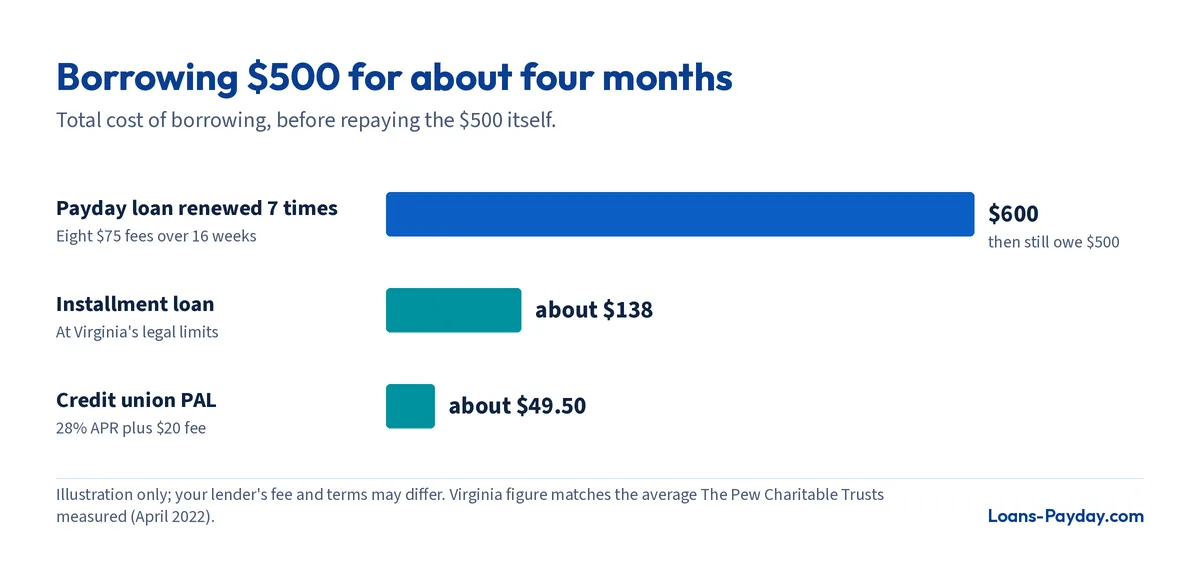
First, a single-payment payday loan at $15 per $100 borrowed costs a $75 fee for two weeks, which is about 391% APR. If you could not repay it and renewed it seven times, paying only the fee each time, you would pay eight $75 fees over 16 weeks, or $600, and still owe the original $500, for $1,100 in total. Many states limit or ban renewals, so check the rules on the payday loan laws by state page.
Second, a four-month payday installment loan priced at Virginia’s legal limits, which are 36% simple annual interest plus a monthly maintenance fee of up to the lesser of 8% of the loan or $25 (Va. Code § 6.2-1817; under § 6.2-1817.1 the State Corporation Commission may adjust the $25 figure for inflation), comes to four payments of about $159.51. You would repay about $638 in total, so the loan costs about $138, an APR of about 126%. That matches the average Pew measured in Virginia.
Third, a four-month payday alternative loan from a federal credit union at the 28% APR maximum comes to four payments of about $132.38, or about $29.50 in interest. With the largest application fee allowed, $20, the total cost is about $49.50.
| Illustration: $500 for about four months | Payment | Total cost of borrowing | Total repaid |
|---|---|---|---|
| Payday loan renewed every two weeks ($15 per $100) | $75 fee every two weeks, then $500 | $600 | $1,100 |
| Installment loan at Virginia’s limits | About $159.51 a month | About $138 | About $638 |
| Credit union PAL at 28% APR, $20 fee | About $132.38 a month | About $49.50 | About $549.50 |
Illustration only; your lender’s fee may differ. The PAL total includes the $20 application fee paid separately from the monthly payments.
Where are payday installment loans allowed?
Payday installment loans are legal in some states, capped or banned in others, and the rules vary a lot. Ohio’s law (current version effective October 29, 2018) allows short-term loans of up to $1,000 for 91 days to one year, with interest of up to 28% a year and a monthly maintenance fee of up to the lesser of 10% of the loan or $30 (Ohio Rev. Code §§ 1321.39 and 1321.40). It also caps total fees and charges at 60% of the original loan amount (§ 1321.403). Virginia allows loans of up to $2,500 for four to 24 months at the limits in the example above (Va. Code §§ 6.2-1816 to 6.2-1817).
Other states cap rates at or near 36% APR or do not allow payday lending at all, which effectively rules out high-cost installment loans there. State-by-state limits on amounts, fees, terms and renewals are on the payday loan laws page. If you are an active-duty servicemember or a covered dependent, the Military Lending Act limits most types of consumer loans to a 36% Military Annual Percentage Rate, which counts finance charges, credit insurance premiums and add-on products. It also bars prepayment penalties and mandatory arbitration (CFPB, last reviewed January 12, 2024).
Do lenders check credit for installment loans?
Most lenders check something, though not always your FICO score from the major bureaus. The CFPB lists the factors most installment lenders weigh: your credit score and report, income, existing debts, the loan amount and length, the rates your state permits, and other information such as your bank account transactions. Lenders may run a soft or hard credit check. The CFPB says payday lenders generally don’t use your credit reports or scores to decide, though some use information from specialty consumer reporting companies, so a low score may not rule you out, but it can mean a higher price. The payday loans with bad credit guide covers how that review works.
Whether the loan helps your credit depends on whether the lender reports your payments. The CFPB says most storefront payday lenders do not report payday loan history to the nationwide credit reporting companies, though some use specialty reporting companies. Lenders of personal installment loans may report payments to one or more of the three major credit bureaus, according to the CFPB, and late payments can lower your score. If a loan goes to a debt collector, the collector could report it. Ask the lender before you sign which bureaus, if any, receive your payment history.
Is an installment loan right for you?
An installment loan fits a one-time expense you can repay from income you already expect. It may make sense if a single payday payment would leave you short for rent or groceries, the scheduled payment fits your budget with room left over, and your state caps the total cost. Before you sign, compare each payment with your monthly income. Pew’s figure of about 5% of income is one benchmark.
It is probably the wrong choice if you need the money to cover an ongoing shortfall, if you would use it to repay another payday loan, or if the payment only fits by skipping another bill. In those cases a longer loan can deepen the problem. If you already have a payday loan you cannot repay, the guide on what happens if you can’t repay a payday loan covers payment plans and your rights.
What are the red flags with installment loans?
Repeated refinancing can make an installment loan far more expensive than its first quote. Refinancing, also called renewing or “flipping,” replaces your current loan with a new one, often with new fees and a longer term. In research on traditional consumer finance installment loans, The Pew Charitable Trusts reported that about 2 in 3 loans are consecutively refinanced each year, and that front-loaded fees give lenders a reason to encourage it (Pew, November 5, 2018). The CFPB’s research on online payday installment loans found that 55% of loan sequences experienced a default, and that half of online payday and payday installment borrowers had at least one debit attempt that failed or caused an overdraft over 18 months (CFPB, June 2, 2016).
Watch for these warning signs:
- An offer to refinance or “top up” the loan before you have paid down much of the balance.
- Credit insurance or other add-on products added to the loan amount.
- A lender that will not show the APR, total finance charge and full payment schedule before you sign.
- A penalty for paying the loan off early.
- Any request for a fee before the loan is funded, especially by gift card, wire transfer or cryptocurrency, which the FTC flags as signs of an advance-fee loan scam.
- A lender that is not licensed in your state. Your state’s financial regulator can confirm a license.
Can an installment loan be used to consolidate debt?
An installment loan can combine several debts into one payment, but consolidating only helps when the total cost goes down. The CFPB (last reviewed September 2, 2026) warns that a lower monthly payment often comes from a longer repayment period, which “could mean that you will pay a lot more overall,” and that low introductory rates may rise later. A high-cost payday installment loan is rarely a way to save on other debt, and using one to repay a payday loan only replaces one high-cost loan with another. A nonprofit credit counselor can review a consolidation plan with you before you borrow.
What cheaper options should you check first?
A credit union payday alternative loan costs far less than most payday installment loans, with APRs capped at 28%. Under National Credit Union Administration (NCUA) rules, federal credit unions can offer PAL I loans of $200 to $1,000 for one to six months to members of at least one month, and PAL II loans of up to $2,000 for one to 12 months. Both must be fully repaid in installments, cannot be rolled over, and carry an application fee of no more than $20 (12 CFR 701.21). In February 2026 the NCUA Board extended the 18% interest rate ceiling for most federal credit union loans through September 10, 2027, which keeps the PAL maximum at 28% APR, 10 percentage points above that ceiling.
Some options may cost little or nothing. The FTC suggests asking your creditors for more time to pay, and finding out whether they charge for an extension. The payday loan alternatives guide compares these and other options by cost, speed and risk, and how payday loans work explains the single-payment version in detail.
Installment loan FAQs
Is a payday loan an installment loan?
Most payday loans are not installment loans, because they are repaid in one lump sum on your next payday. The CFPB notes that some payday loans are set up to be repaid in installments over a longer period, and Virginia requires licensed short-term loans to be repaid in substantially equal installments.
Can I get an installment loan with bad credit?
Some lenders offer installment loans to borrowers with poor credit, usually at higher rates. Lenders weigh income, existing debt and bank account history along with credit reports, and approval is never certain at any score. A credit union PAL may cost less if you are a member or can join.
How many payments does a payday installment loan have?
The number of payments depends on your state’s law and the lender’s terms. Ohio allows terms of 91 days to one year, Virginia allows four to 24 months, and credit union PALs run one to 12 months. Ask for the full payment schedule, with each amount and due date, before you sign.
Can I pay off an installment loan early?
Check the agreement for a prepayment penalty before you sign, and ask the lender how much paying early would save you. For active-duty servicemembers and covered dependents, the Military Lending Act prohibits prepayment penalties on covered loans, according to the CFPB.
What is the difference between an installment loan and a personal loan?
A personal loan is one type of installment loan, typically from a bank, credit union or online lender, used for any personal purpose. “Installment loan” is the broader term for any loan repaid in scheduled payments, including payday installment loans, car loans and mortgages.
Will an installment loan help my credit score?
It can help only if the lender reports your payments to the major credit bureaus. The CFPB says most storefront payday lenders do not report to them, while personal installment lenders may. Late or missed payments, or a debt sent to collections, can lower your score.
Updated October 2026. This page is general information, not financial or legal advice.